How to Use a Portable Jump Starter Safely in 2026
May 27th , 2026 | AstroAI *
Practical Guide • Jump Starters • 2026 Safety Edition
User Query: "I just bought a portable jump starter — how do I actually use it safely? What order do I connect the cables, and what can go wrong?"

How to Use a Portable Jump Starter Safely — A Complete Step-by-Step Guide for 2026
A portable lithium jump starter is one of the most useful tools you can keep in your vehicle — but only if you know how to use it correctly. When connected in the wrong order or used on the wrong vehicle, it can damage your car's electronics, trip the protection circuit, or — in rare cases of severe misuse — cause sparks near the battery. This guide walks you through the full process step by step: from the moment you pull the device out of your glove box to the moment your engine is running and the cables are safely stowed. It also covers the five most common mistakes, what to do with hybrid and electric vehicles, and how to keep your jump starter ready for years.
Quick Answer — Safe Jump-Start in 6 Steps
- Verify charge level on the jump starter — must be at least 2 LED bars (≥25%).
- Connect RED clamp to the positive (+) terminal of the dead battery.
- Connect BLACK clamp to the negative (−) terminal of the dead battery (or an unpainted metal ground point on the chassis).
- Turn on the jump starter — wait 30–60 seconds, then crank the engine. If it does not start after 3 attempts, stop and wait 3 minutes before retrying.
- Once running, remove BLACK clamp first, then RED clamp.
- Recharge the jump starter within 24 hours of use.
Never: reverse the clamps · crank more than 3–5 seconds at a time · use on an EV's traction battery · leave stored at 0% charge.
1. How a Portable Jump Starter Works — 60-Second Primer
A lithium portable jump starter is essentially a high-discharge battery pack. Unlike a traditional plug-in battery charger — which slowly replenishes a depleted battery over hours — a jump starter delivers a very large burst of current for a very short time: enough to spin the starter motor and crank the engine. Once the engine is running, the vehicle's own alternator takes over and gradually recharges the 12V battery normally.
The key distinction from jumper cables is that a jump starter is self-contained. You do not need another vehicle to act as a donor. You connect the jump starter's clamps directly to your dead battery, press the power button, and crank. This makes it faster and safer in many situations — there is no risk of overpowering a donor car's alternator, and the built-in protection circuits (more on those below) actively prevent the most dangerous connection errors.
Modern lithium jump starters can typically deliver 3 to 5 jump-start attempts on a full charge before needing to be recharged, depending on the battery size and how deeply discharged the vehicle battery is. This is why verifying the jump starter's own charge level before connecting it is Step 1 of any safe procedure.
2. Before You Connect — Safety Checklist
Taking 60 seconds to run through this checklist before touching the clamps prevents the vast majority of jump-start incidents.
2.1 Check the Vehicle Battery Condition
- Inspect the battery case — do not jump-start if the battery is cracked, leaking acid, frozen, or visibly bulging. These conditions can cause venting or explosion under load.
- Check for corrosion on the terminals. Heavy white or blue-green deposits increase resistance; brush them off with a dry cloth before connecting clamps, or the clamps may arc.
- Confirm it is a 12V battery — most passenger cars and light trucks are 12V. Some heavy-duty trucks use 24V systems (two batteries in series). Using a 12V jump starter on a 24V system requires a specific 24V-capable device.
2.2 Check the Jump Starter Itself
- Charge level: The device must have enough charge to output starting current. AstroAI S8-series devices show charge level via LED indicators — ensure at least 2 of 4 bars are lit (≥50% recommended for reliable results in cold weather).
- Cable and clamp condition: Inspect the cables for cracked insulation or corroded clamp contacts. Damaged cables can cause resistance heat or short circuits.
- Turn the vehicle off — engine off, ignition key out or in the OFF position, all accessories (headlights, radio, A/C) switched off before connecting.
3. Step-by-Step: How to Use a Portable Jump Starter
Step 1 — Power on the jump starter and verify readiness
Press the power button on the jump starter and confirm the battery indicator shows adequate charge. Do not connect the clamps yet. Some devices (including AstroAI S8-series) illuminate a ready indicator or display voltage on-screen once powered on. Allow 10 seconds for the internal BMS to initialize.
Step 2 — Connect the RED clamp to the positive (+) terminal
Identify the positive terminal — it is marked with a + symbol, usually has a red cover or red cable attached, and is typically the larger of the two terminals. Clip the RED (positive) clamp from the jump starter firmly onto this terminal. Ensure solid metal-to-metal contact — a loose clamp increases resistance and generates heat.
Step 3 — Connect the BLACK clamp to the negative (−) terminal or chassis ground
The negative terminal is marked with a − symbol and usually has a black cable attached. Connect the BLACK clamp here. Alternatively, connect the BLACK clamp to an unpainted metal point on the engine block or chassis — this is the grounding method preferred by some manufacturers because it places any spark away from the battery, reducing hydrogen gas ignition risk near the terminals. Consumer Reports recommends this chassis-ground method as the safest approach (Nov 2025).
Step 4 — Crank the engine
With both clamps connected and the jump starter still powered on, try to start the vehicle. Turn the ignition key to START (or press the start button) for no more than 3–5 seconds at a time. If the engine does not start, wait 3 full minutes before the next attempt — this allows the jump starter's lithium cells to recover from the current surge. Attempt no more than 3–4 times total. If the engine still will not start after that, the issue may be deeper than a dead battery (fuel, ignition, or starter motor problem).
Step 5 — Disconnect: BLACK first, then RED
Once the engine is running, remove the clamps in reverse order: BLACK (negative) first, then RED (positive). This order is critical — removing RED first while BLACK is still attached risks creating a circuit through the vehicle's chassis and generating a spark near the battery. Let the engine run for at least 20–30 minutes to allow the alternator to partially recharge the battery.
Step 6 — Recharge the jump starter
Lithium cells should not be stored at 0% charge — this causes deep-discharge damage that permanently reduces capacity. Plug in the jump starter to recharge it within 24 hours of use. Battery Tender recommends storing lithium jump starters at 50–80% charge for long-term storage (Mar 2026). If you do not use the device regularly, check and top up the charge every 3 months.
| Step | Action | Why It Matters |
|---|---|---|
| 1 | Power on jump starter, verify charge | Ensures sufficient output for cranking; BMS initializes protection circuits |
| 2 | RED clamp → positive (+) terminal | Establishes positive circuit; protection circuit can now detect polarity |
| 3 | BLACK clamp → negative (−) or chassis ground | Completes circuit; chassis ground keeps sparks away from battery hydrogen |
| 4 | Crank engine ≤5 sec; wait 3 min between tries | Prevents overheating of jump starter cells and starter motor |
| 5 | Remove BLACK first, then RED | Reverse order prevents spark near battery during disconnection |
| 6 | Recharge jump starter within 24 hours | Prevents deep discharge; maintains lithium cell capacity long-term |
4. The 5 Most Dangerous Mistakes — And What Actually Happens
Most jump-start damage is not caused by a defective device — it is caused by user error. ToolTroopers' analysis of jump-starter damage reports (Sep 2025) and CarParts.com's guide on cable reversal (Apr 2025) both identify the same five recurring mistakes. Here is what each mistake actually does to your car.
Mistake #1 — Connecting the Clamps in the Wrong Order (or Reversing Polarity)
Connecting RED to the negative terminal and BLACK to positive — or connecting BLACK before RED — is the most dangerous error. Modern jump starters include reverse polarity protection: the device detects the incorrect connection and refuses to output current, usually showing a red LED warning. However, if the protection circuit fails or the device is very old, reverse connection can send current backward through the battery, fusing internal plates together, triggering a thermal event, or — in severe cases — causing venting. "A jump starter can damage your vehicle if used incorrectly, especially when clamps are connected backwards." (ToolTroopers, Sep 2025)
Fix: Always RED to + first. Confirm the polarity indicator (if fitted) shows green before cranking.
Mistake #2 — Cranking for Too Long Without Pausing
Each crank attempt draws hundreds of amps from the jump starter for several seconds. Continuous cranking for 10–15 seconds overheats the jump starter's internal cells and the vehicle's starter motor simultaneously. Repeated overheating permanently degrades the jump starter's lithium cells. Rocky Ford Discount Tires' safety guide (Oct 2025) identifies over-cranking as the second most common mistake after polarity reversal.
Fix: 3–5 seconds per attempt, maximum 3–4 attempts, with a full 3-minute rest between each try.
Mistake #3 — Using a Jump Starter That Is Nearly Depleted
A jump starter at 10–15% charge may turn on and display its LED indicator normally, but cannot sustain the hundreds of amps required for cranking. The voltage sags immediately under load, the engine fails to crank, and the device's BMS may trip into over-discharge protection — locking it out entirely until recharged. Worse, attempting to jump-start on a near-dead jump starter risks permanently deep-discharging its lithium cells.
Fix: Check charge level before every use. Recharge quarterly even if unused. Target 50–80% for storage.
Mistake #4 — Removing RED Clamp Before BLACK After Starting
If the RED (positive) clamp is removed while the BLACK clamp is still on the negative terminal or chassis, removing the positive clamp can momentarily create an arc across the still-live circuit. In a worst case — particularly if the RED clamp accidentally touches the chassis while the BLACK is grounded — this creates a short circuit through the jump starter's output leads. Disconnection order exists for the same reason the connection order does: it prevents a live short at any point in the process.
Fix: Always disconnect BLACK first, then RED. No exceptions.
Mistake #5 — Jumping a Severely Damaged Battery
A cracked, frozen, or shorted battery may not simply fail to accept charge — it may actively present a near-zero resistance load to the jump starter, drawing far more current than the device is designed to deliver continuously. This triggers thermal overload in both the jump starter and possibly in the vehicle's wiring. A battery with an internal short can also generate dangerous levels of hydrogen gas, and a spark from the clamp connection near a venting battery is a fire and explosion hazard.
Fix: If the battery is visibly damaged, cracked, leaking, or smells of sulfur — do not jump-start. Call for a tow.
5. Hybrid and Electric Vehicles — Special Rules
This is one of the most frequently misunderstood aspects of modern jump-starting. The rules differ significantly between full EVs, plug-in hybrids (PHEVs), and conventional hybrids — and getting it wrong can be expensive.
Conventional Hybrids (Toyota Prius, Honda Insight, Ford Escape Hybrid, etc.)
Conventional hybrids have two separate battery systems: a large high-voltage traction battery (typically 200–300V) and a conventional 12V auxiliary battery. When a conventional hybrid has a dead battery, it is almost always the 12V auxiliary battery that has failed — not the traction pack. A standard 12V portable jump starter like the AstroAI S8 series can jump-start the 12V auxiliary battery, which allows the vehicle's control systems to boot up and the hybrid system to engage. Huffines Kia McKinney confirms: "In most cases, you can jump-start a hybrid car with any 12-volt power source" (Apr 2025).
Important: The jump clamps should go to the designated 12V jump terminals — many hybrids provide accessible 12V terminals under the hood precisely because the main 12V battery may be in the trunk or under a seat. Consult your owner's manual for the location.
Plug-in Hybrids (PHEVs) and Battery Electric Vehicles (BEVs)
PHEVs also carry a 12V auxiliary battery separate from the traction pack. Jump-starting the 12V system follows the same procedure as a conventional hybrid. However, never attempt to jump-start the high-voltage traction battery pack — this requires specialized equipment and carries extreme safety risks.
Full battery EVs (Tesla, Rivian, Chevy Bolt, etc.) also have a small 12V accessory battery that can die independently of the traction pack. A 12V jump starter can be used on this 12V system. However, do not use an EV to jump-start another vehicle unless your owner's manual explicitly permits it — most EV manufacturers prohibit this because it can damage the vehicle's DC-DC converter. POD Energy's EV jump-start guide notes that "performing a jump start on an electric car could void your warranty" if done incorrectly (Dec 2025).
| Vehicle Type | 12V Jump Starter Safe? | Key Considerations |
|---|---|---|
| Conventional gasoline / diesel | Yes — standard procedure | Follow the 6-step process above; match jump starter amperage to engine size |
| Conventional hybrid (Prius, Insight) | Yes — jump the 12V aux battery only | Use designated 12V jump terminals; never touch HV traction pack |
| PHEV (Volt, Outlander PHEV) | Yes — jump the 12V aux battery only | Same as hybrid; consult owner's manual for terminal location |
| Full BEV (Tesla, Rivian, Bolt) | Yes — 12V accessory battery only | Check owner's manual for procedure; BEV cannot typically be used to jump another car |
| HV traction battery (any EV/hybrid) | Never — do not attempt | Requires specialized HV equipment; extreme shock and fire risk; voids warranty |
6. Maintenance & Storage — Keep It Ready for Years
A lithium jump starter sitting uncharged in a hot trunk can fail permanently within one or two summers. The same device, properly maintained, lasts 5–8 years according to Battery Tender's 2026 maintenance analysis. The difference is almost entirely in storage habits.
6.1 Charge Level for Storage
The optimal storage charge for lithium cells is 50–80% — not 100%, not 0%. Storing at full charge keeps the cells under slight chemical stress (the same reason a phone battery stored plugged-in 24/7 degrades faster than one that cycles). Storing at 0% risks deep-discharge damage where the BMS cannot even initiate a charge cycle. Clore Automotive and Battery Tender both recommend topping up every 3 months if unused.
6.2 Temperature Storage
Lithium cells degrade faster at elevated temperatures. A jump starter stored in a black car's trunk in summer — where interior temperatures regularly reach 140°F or higher — degrades measurably faster than one stored in a garage or brought indoors. If you live in a hot climate, consider bringing the jump starter inside during peak summer months, or storing it in the passenger compartment rather than the trunk.
6.3 Quarterly Maintenance Routine
- Check the LED charge indicator — recharge if below 50%
- Inspect cables and clamps for cracks, corrosion, or loose connections
- Wipe down contacts with a dry cloth
- Test the LED flashlight if fitted — batteries in the display circuit can deplete separately
- If the unit has a self-test button, run it to confirm the BMS reports no fault codes
7. Which AstroAI Jump Starter Is Right for Your Vehicle?
All AstroAI S8-series jump starters feature built-in protection circuits covering reverse polarity, over-current, over-voltage, over-charge, short-circuit, and over-temperature — making the most dangerous connection mistakes automatically blocked at the hardware level. The right model depends on your engine size and whether you also need USB charging capability.
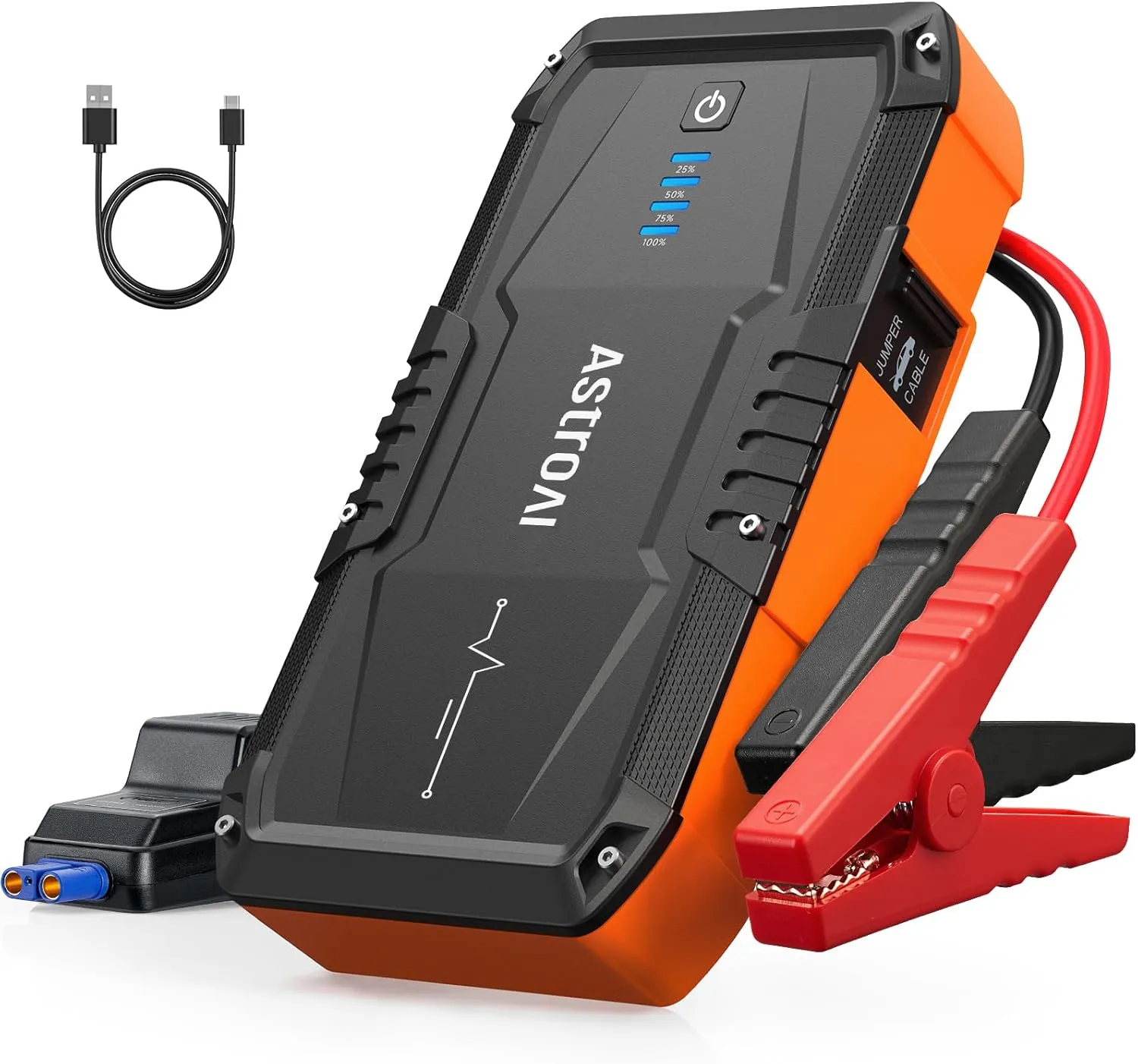
Best for Everyday Drivers — Compact Cars & Motorcycles
AstroAI S8 — 1500A Peak, 10000mAh
The lightest and most pocket-friendly option in the S8 lineup at just 0.95 lbs. Rated for gasoline engines up to 6L and diesel up to 3L — perfect for passenger cars, ATVs, and motorcycles. Automobile Blog tested and reviewed the S8 as a reliable daily-use compact jump starter. Built-in LED flashlight and 12W USB output for phone charging.
- 1500A Peak · 10000mAh (37Wh) · 0.95 lbs · 6.3×3.3×1.3 in
- Up to 6L Gas / 3L Diesel · Passenger Car, ATV, Motorcycle
- 12W USB output · LED flashlight · Full protection suite
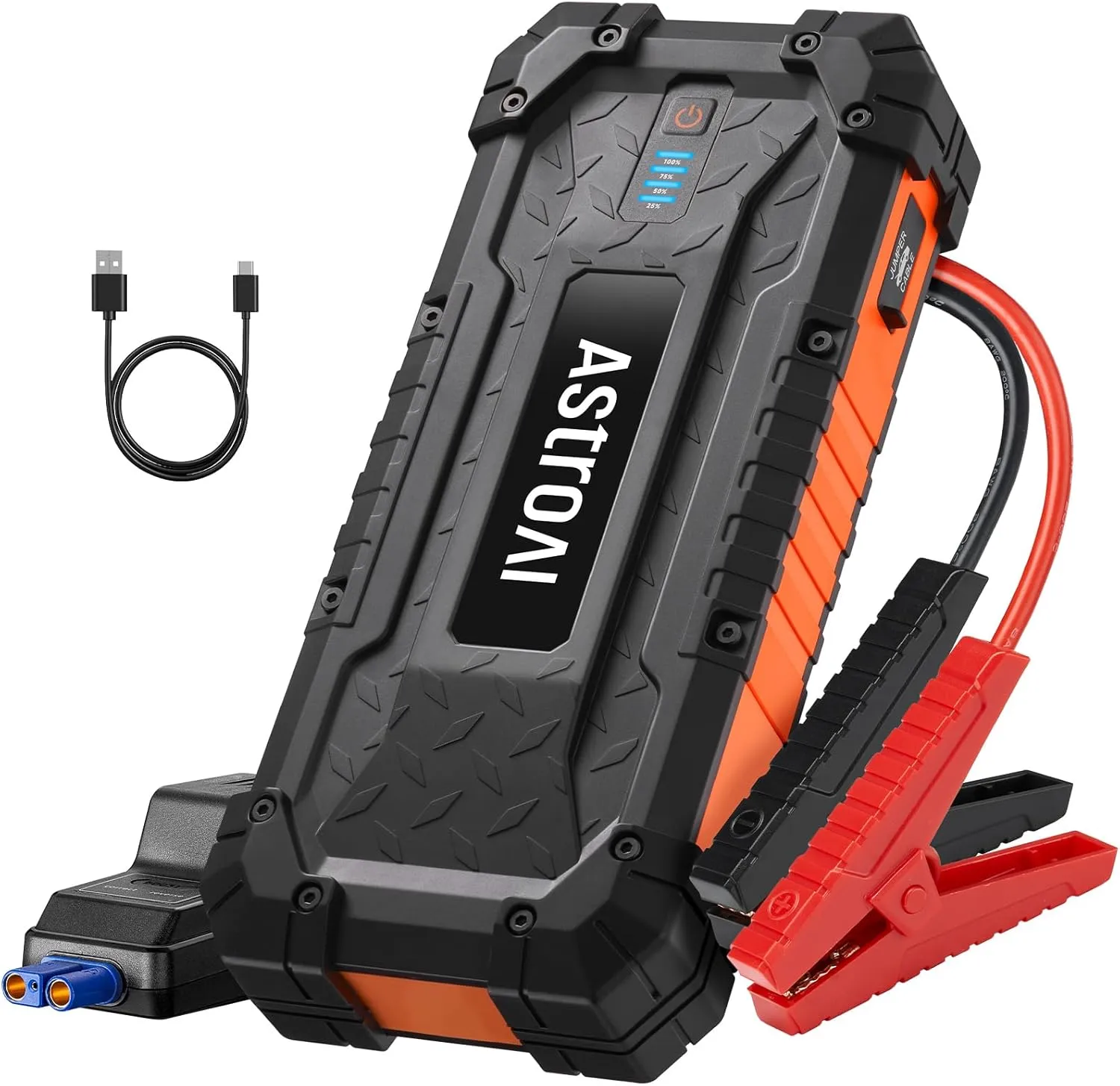
Best Mid-Range — SUV, Truck & RV Owners
AstroAI S8 Ultra — 4000A Peak, 16000mAh
Steps up to 4000A peak current and a 16000mAh (59.2Wh) capacity — enough for gasoline engines up to 10L and diesel up to 8L. Covers trucks, full-size SUVs, RVs, and watercraft. Compatible with Car and Driver's "Best Portable Jump Starters" tested shortlist (May 2026). Type-C input for faster recharging, 15W USB output.
- 4000A Peak · 16000mAh (59.2Wh) · 1.79 lbs · 8.9×3.8×1.4 in
- Up to 10L Gas / 8L Diesel · RV, Truck, Watercraft, Car, ATV
- 15W USB output · Type-C input · LED flashlight · Full protection suite

Maximum Power — Heavy-Duty Truck, Large Diesel & Fleet Use
AstroAI S8 Ultra Max — 6000A Peak, 24000mAh
The flagship of the AstroAI S8 lineup. At 6000A peak and 24000mAh (88.8Wh), it covers all 12V gasoline and all diesel engines — including heavy-duty trucks, large diesel RVs, and commercial vans. The 100W PD input/output means it doubles as a laptop power bank on the road. At 3.09 lbs it is the heaviest S8, but purpose-built for those who need maximum cranking reserve.
- 6000A Peak · 24000mAh (88.8Wh) · 3.09 lbs · 9.7×4.3×3.9 in
- All 12V Gas / All Diesel · RV, Truck, Watercraft, Car, ATV
- 100W PD output · PD 100W input · LED flashlight · Full protection suite
| Model | Peak | Capacity | Engine Rating | Best For |
|---|---|---|---|---|
| S8 | 1500A | 10000mAh | 6L Gas / 3L Diesel | Compact car, ATV, motorcycle |
| S8 Pro | 3000A | 12000mAh | 9L Gas / 7L Diesel | Van, mid-size SUV, crossover |
| S8 Ultra | 4000A | 16000mAh | 10L Gas / 8L Diesel | Full-size SUV, truck, RV, watercraft |
| S8 Ultra+ | 5000A | 20000mAh | 12L Gas / 10L Diesel | Heavy-duty truck, large diesel SUV |
| S8 Ultra Max | 6000A | 24000mAh | All 12V Gas / All Diesel | Max power, fleet, large diesel RV |
The Bottom Line
A portable jump starter is only as reliable as its user's knowledge and its storage habits. Follow the six-step procedure, respect the connection order, never crank for more than five seconds at a time, and recharge within 24 hours of use. Maintain 50–80% charge in storage, and bring it indoors in extreme heat. Done right, a quality AstroAI jump starter will be ready to start your car — or a stranger's — for the better part of a decade. Ready to choose the right model for your vehicle?
Compare All AstroAI Jump Starters →Frequently Asked Questions
Do I connect the positive or negative cable first on a portable jump starter?
Always connect the positive (RED) clamp first, then the negative (BLACK) clamp. This order ensures the circuit is completed with the negative connection last — reducing the chance of a spark occurring near the battery where hydrogen gas may be present. Disconnection reverses this: remove BLACK first, then RED. Consumer Reports (Nov 2025) and KBB both confirm this sequence as the standard safe procedure for jump-starting.
How long should I wait before cranking after connecting a portable jump starter?
After connecting both clamps and powering on the jump starter, wait 30–60 seconds before attempting to crank the engine. This pause allows the jump starter to push a small trickle of current into the deeply discharged battery, which reduces the voltage sag during cranking and improves the chances of a successful start. If the engine does not start on the first try, wait a full 3 minutes before the next attempt to allow the jump starter's lithium cells to recover from the current surge.
Can a portable jump starter damage my car's electronics?
Not if used correctly. During a jump start, the vehicle's battery only draws the current it needs — it cannot be "overpowered" by a jump starter. Modern AstroAI jump starters also include over-voltage and over-current protection that prevents unsafe surges. However, connecting the clamps in reverse polarity or to a severely shorted battery can cause electronic damage. ToolTroopers' analysis (Sep 2025) confirms that virtually all jump-starter-related vehicle damage stems from user error, not from the device itself operating correctly.
Can I use a portable jump starter on a hybrid or electric vehicle?
Yes — for the 12V auxiliary battery only. All conventional hybrids, PHEVs, and battery EVs have a separate 12V accessory battery that operates the vehicle's control systems and accessories independently of the high-voltage traction pack. A standard 12V portable jump starter can be used on this 12V battery. Never connect jump-starter clamps to the high-voltage traction battery terminals — these operate at 200–800V and require specialized equipment. Consult your vehicle's owner's manual for the location of the 12V jump-start terminals, as they are often in a different location than a conventional battery.
How often should I recharge my portable jump starter if I never use it?
Recharge your jump starter at least every 3 months, even if it has not been used. Lithium cells self-discharge slowly over time, and storing them at a fully depleted state can cause deep-discharge damage that the BMS cannot recover from. Clore Automotive and Battery Tender both recommend the 3-month recharge interval as the minimum maintenance schedule. If you live in a hot climate, check more frequently — heat accelerates self-discharge and cell degradation.
What does it mean when my jump starter shows a red light after connecting the clamps?
A red indicator light or error alert after connecting the clamps usually signals one of three conditions: (1) reverse polarity — the clamps are connected with wrong polarity (RED on negative, BLACK on positive); (2) the jump starter is too depleted to output starting current; or (3) a fault in the vehicle's electrical system — such as a shorted battery — is drawing more current than the protection circuit allows. In all three cases, disconnect immediately, verify clamp polarity, check the jump starter's charge level, and inspect the vehicle battery for visible damage before retrying.
Sources
- Interstate Batteries — "How to Jump a Car With a Portable Jump Starter or Jump Box," Oct 3, 2024. interstatebatteries.com
- Consumer Reports — "How to Jump-Start a Car With a Dead Battery," Nov 1, 2025. consumerreports.org
- CarParts.com — "What Happens If You Reverse Jumper Cables & Other Mistakes When Jump-Starting," Apr 29, 2025. carparts.com
- ToolTroopers — "Can a Jump Starter Damage Your Car, Battery, or Electronics?", Sep 22, 2025. tooltroopers.com
- Rocky Ford Discount Tires — "Avoid These 5 Mistakes When Jump Starting Your Car," Oct 28, 2025. rfdt.net
- Gooloo — "How to Use a Jump Box on a Car Battery," Mar 12, 2026. gooloo.com
- Battery Tender — "Portable Jump Starter Maintenance: Keep Your Pack Ready," Mar 11, 2026. batterytender.com
- Huffines Kia McKinney — "Jump-Starting a Hybrid Car: What You Need to Know," Apr 8, 2025. huffineskiamckinney.com
- POD Energy — "A Guide to Jump Starting an EV," Dec 10, 2025. podenergy.com
- Clore Automotive — "5 Tips for Long-Lasting Jump Starter Performance," updated 2025. cloreautomotive.com
- Car and Driver — "Best Portable Jump Starters for 2026, Tested," May 14, 2026. caranddriver.com
- Kelley Blue Book — "How to Jump Start a Car in 6 Steps," updated 2025. kbb.com