How to Test a Car Battery and Alternator with a Multimeter in 2026
May 26th , 2026 | AstroAI *
Buyer's Guide • Multimeters • 2026 Automotive Edition
User Query: "I want to check if my car battery is still good and whether the alternator is charging properly — can I do this myself with a multimeter?"

How to Test a Car Battery and Alternator with a Multimeter — A Complete 2026 DIY Guide
Battery and electrical failures account for 25.9% of all roadside assistance calls in the United States — making them the single largest cause of vehicle breakdowns (ToolTroopers, Apr 2026). The good news: a basic digital multimeter and five minutes of your time can tell you whether your battery is healthy, whether it can handle a cold crank, and whether your alternator is keeping it charged — before you're stranded at 6 AM. This guide walks you through the three-step test in plain language, with the exact voltage numbers to look for at each stage.
Quick Answer — The 3-Step Multimeter Test
- Step 1 — Static voltage (engine off): Set meter to DC 20V. Red probe to +, black to −. Healthy battery reads 12.6 V or above. Below 12.0 V = replace.
- Step 2 — Cranking load test (engine starting): Watch voltage as you crank. Healthy battery stays at ≥ 10.0 V. Drops below 9.6 V = weak battery.
- Step 3 — Alternator/charging test (engine running): Voltage should climb to 13.8–14.7 V. Below 13.5 V = alternator suspect. Above 15.0 V = voltage regulator fault.
- Recommended meters: AstroAI DT132A (best DIY value), DM6000AR (True-RMS upgrade), MUS10KRD (EV/hybrid pro).
1. Why a Multimeter Can Replace a $90 Shop Diagnostic Fee
Walk into any auto parts store and they will test your battery for free — but they won't hand you the raw numbers or tell you why the voltage is where it is. A dealership or independent shop that does a charging-system diagnostic typically bills $75–$120 per hour, even before any parts are touched. A digital multimeter costing under $40 gives you the same voltage measurements and lets you interpret them yourself, at any time.
Beyond cost, there is a timing advantage. Battery failures do not announce themselves a week in advance — they happen on cold mornings or mid-trip when internal resistance spikes. A five-minute multimeter check every month or before a road trip gives you a leading indicator, not a lagging diagnosis.
There is also growing data on why this matters more in 2026 than it did five years ago. The average U.S. vehicle on the road is now 12.6 years old (S&P Global Mobility, 2025), and vehicles older than ten years account for more than 66% of all roadside breakdowns (ToolTroopers, Apr 2026). An aging fleet means more batteries operating past their three-to-five-year service window.
2. What You Need Before You Start
2.1 Equipment
- A digital multimeter with a DC voltage range of at least 20V (any AstroAI multimeter qualifies)
- Clean test leads in good condition — inspect for cracked insulation before each use
- Safety glasses (battery terminals can spark briefly on contact)
- A helper to crank the engine during Step 2 (or use the meter's data-hold feature)
2.2 Multimeter Setup
For all three tests in this guide, set your multimeter to DC Voltage (V DC or V—), range 20V. Do not use the AC setting (V~) — a car battery is a DC source. Plug the red lead into the V/Ω jack and the black lead into COM. If your meter is auto-ranging (like the AstroAI DM6000AR or MUS10KRD), simply select DC volts and let the meter pick the range automatically.
2.3 Safety
- Never test with the engine running and the hood propped unsecured
- Keep metal tools away from the battery terminals to avoid short circuits
- If the battery case is cracked, bulging, or leaking, do not test it — replace it immediately
- A 12V car battery is not lethal by voltage alone, but short-circuit currents can exceed 1,000 A and cause severe burns or fires
Time required: approximately 5–8 minutes for all three steps, including engine warm-up time.
3. Step 1 — Static Battery Voltage Test (Engine Off)
This test measures your battery's resting state of charge. For accurate results, the engine must have been off for at least 30 minutes — ideally two hours after any charging or driving. Surface charge from recent use can inflate the reading by 0.1–0.3V.
Procedure
- Turn off the engine and all accessories (lights, radio, A/C)
- Locate the battery — usually under the hood, but some vehicles place it in the trunk or under a rear seat
- Set your multimeter to DC 20V
- Touch the red probe to the positive (+) terminal and the black probe to the negative (−) terminal
- Read the voltage on the display and compare to the table below
Voltage-to-Charge-State Reference
| Voltage Reading | State of Charge | Action |
|---|---|---|
| 12.6 V and above | Full charge (100%) | Battery is healthy — proceed to Step 2 |
| 12.4 V | ~75% charge | Acceptable — check alternator in Step 3 |
| 12.2 V | ~50% charge | Charge the battery first, then retest |
| 12.0 V | ~25% charge | Battery nearing failure — load test urgently |
| Below 11.9 V | Discharged / damaged | Replace battery — do not attempt to jump-start repeatedly |
Why resolution matters here: A 2000-count meter reading in the 12V range will display values in 0.1V increments (12.4V, 12.5V…). A 4000-count meter like the AstroAI DT132A resolves to 0.01V — so you see 12.45V versus 12.46V. That finer reading makes a genuine difference when a battery is hovering near the 12.4V borderline. CarParts.com notes the healthy resting range as 12.4–12.7V (Apr 2025) — at 0.1V resolution you cannot confidently distinguish between a battery at 12.45V and one at 12.35V.
4. Step 2 — Cranking Load Test (Engine Starting)
The static voltage test tells you the battery's charge level. The cranking test tells you whether it can actually deliver current under load — which is what matters on a cold morning when the starter motor demands several hundred amps. A battery can read 12.5V at rest but collapse to 8V under load, indicating severe internal sulfation.
Procedure
- Leave the multimeter probes on the battery terminals from Step 1 (or reconnect them)
- Disable the ignition fuel injection if possible (hold the clutch pedal on a manual, or pull the fuel pump fuse on some vehicles) — this prevents the engine from fully starting so you can observe the crank voltage longer. This step is optional for a basic check.
- Have a helper crank the engine (turn the ignition key to Start). Watch the voltage on the meter display.
- Record the lowest voltage shown during cranking
- Allow the engine to start and idle normally
Cranking Voltage Interpretation
| Lowest Cranking Voltage | Interpretation |
|---|---|
| 10.0 V or above | Healthy battery — good cold-cranking reserve |
| 9.6 V – 9.9 V | Marginal — battery may fail in cold weather; plan for replacement |
| Below 9.6 V | Weak / failing battery — replace before winter or long trips |
Tip: if your meter has a MIN/MAX hold function (the AstroAI DT132A, DM6000AR, and MUS10KRD all do), enable it before cranking. The meter will capture the lowest dip even if the crank is brief. This is especially useful when you are both turning the key and watching the display yourself.
5. Step 3 — Alternator & Charging System Test (Engine Running)
With the engine idling, your alternator should be generating AC voltage internally and converting it to regulated DC to charge the battery. A healthy charging system holds the battery terminal voltage in the 13.8–14.7V band. This step identifies whether low battery voltage is caused by the battery itself or by an alternator that is failing to charge it.
Procedure
- Start the engine and let it idle for 2 minutes (the alternator output stabilizes after warm-up)
- Keep the multimeter probes on the battery terminals — same position as Steps 1 and 2
- Read the voltage. It should be noticeably higher than your Step 1 resting voltage.
- Now turn on the electrical load: headlights on high beam, A/C at maximum, heated rear window. This is the high-load verification.
- Read the voltage again under full load. A healthy alternator holds voltage above 13.5V even with these loads on.
Charging Voltage Reference
| Running Voltage | Meaning | Likely Cause |
|---|---|---|
| 13.8 – 14.7 V | Normal charging range | Alternator and voltage regulator functioning correctly |
| 13.5 – 13.7 V | Low-normal — acceptable at idle | Recheck at higher RPM (~2,000); may improve |
| Below 13.5 V | Undercharging | Worn alternator, broken drive belt, or corroded connections |
| 12.0 – 13.0 V | Battery supplying power — alternator not working | Alternator failure — vehicle will eventually stall |
| Above 15.0 V | Overcharging | Voltage regulator fault — can damage battery and electronics |
Why True-RMS matters for modern vehicles: Many 2020+ vehicles use smart alternators with PWM (pulse-width modulation) output — they deliberately vary charging voltage based on regenerative braking strategy and battery state. A non-True-RMS meter can read PWM-modulated DC signals 5–15% off the actual average value. If you own a modern vehicle with start-stop technology or mild hybrid architecture, a True-RMS meter like the AstroAI DM6000AR or MUS10KRD gives you a more reliable reading of the actual charging voltage.
6. Full Diagnostic Decision Tree
After completing all three steps, combine the readings to pinpoint the problem. Use this table as your final diagnostic:
| Step 1 (Static) | Step 2 (Crank) | Step 3 (Running) | Diagnosis | Recommended Action |
|---|---|---|---|---|
| ≥ 12.6 V | ≥ 10.0 V | 13.8–14.7 V | All systems healthy | No action needed |
| 12.2–12.5 V | ≥ 10.0 V | 13.8–14.7 V | Low charge, good alternator | Charge battery; check driving patterns (short trips prevent full recharge) |
| ≥ 12.6 V | < 9.6 V | 13.8–14.7 V | Weak battery, good alternator | Replace battery — internal resistance too high despite surface charge |
| 12.2–12.5 V | Any | < 13.5 V | Battery undercharged + alternator weak | Inspect alternator belt, connections; test alternator output at 2,000 RPM |
| Any | Any | 12.0–13.0 V | Alternator failed | Replace alternator; vehicle will drain battery while running |
| Any | Any | > 15.0 V | Voltage regulator fault | Have voltage regulator replaced — overcharging damages battery and electronics |
7. Which AstroAI Multimeter Is Right for Car Testing?
Any multimeter that reads DC voltage in the 0–20V range can perform these three tests. The choice comes down to how precise you want the readings, whether you work on modern vehicles with PWM charging systems, and whether you use the meter for other purposes beyond the car.
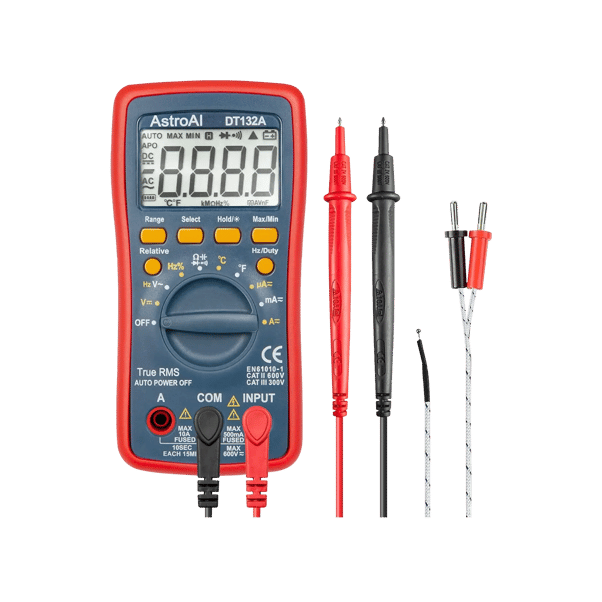
Best for Automotive DIY
AstroAI DT132A — 4000 Counts, True-RMS
The DT132A is the strongest value choice for battery and alternator testing. Its 4000-count display resolves voltage to 0.01V — so instead of reading "12.4V" you see "12.45V," which is meaningful when your battery is hovering near the 12.4V service threshold. True-RMS ensures accurate readings on modern vehicles with smart alternators. It also includes a built-in flashlight (useful when probing a dark engine bay), temperature measurement, and duty-cycle testing. DC voltage range: up to 600V. Ranging: manual + auto.
- 4000 counts · True-RMS · DC 600V · AC 600V
- Temperature, capacitance, frequency (5 MHz), duty cycle
- Flashlight · Min/Max Hold · Auto power-off
- CAT III rated — safe for vehicle electrical system
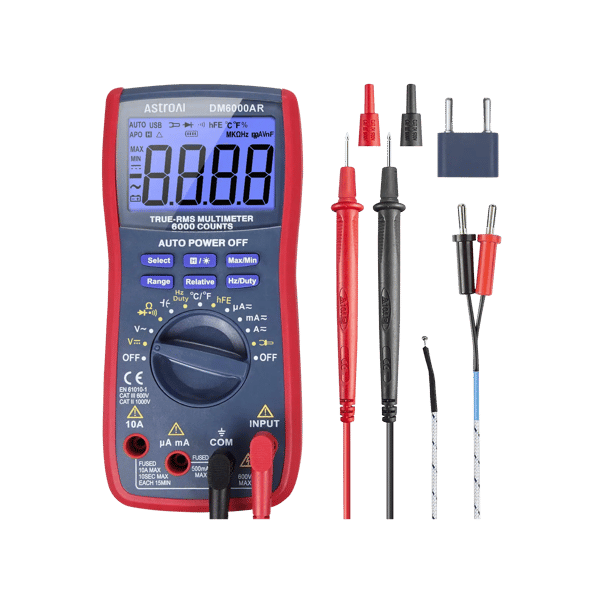
Best Value Upgrade — Car + Home
AstroAI DM6000AR — 6000 Counts, True-RMS
If you also use your multimeter for home electrical work, the DM6000AR is a compelling step-up. Expert Reviews UK named it "Best-value, most feature-packed" in its 2024 roundup. For automotive use, its 6000-count True-RMS display gives you 0.001V resolution on the 20V DC range — excellent for comparing alternator output under varying loads. DC range extends to 1000V, making it safe for EV 12V auxiliary battery systems. It adds 0–60 MHz frequency measurement — useful if you are also diagnosing sensor signals or PWM outputs on modern engine management systems.
- 6000 counts · True-RMS · DC 1000V · AC 750V
- Frequency 0–60 MHz · Capacitance · Temperature · Duty cycle
- Flashlight · Min/Max Hold · Auto + Manual ranging
- Expert Reviews UK: "Best-value, most feature-packed" (Nov 2024)
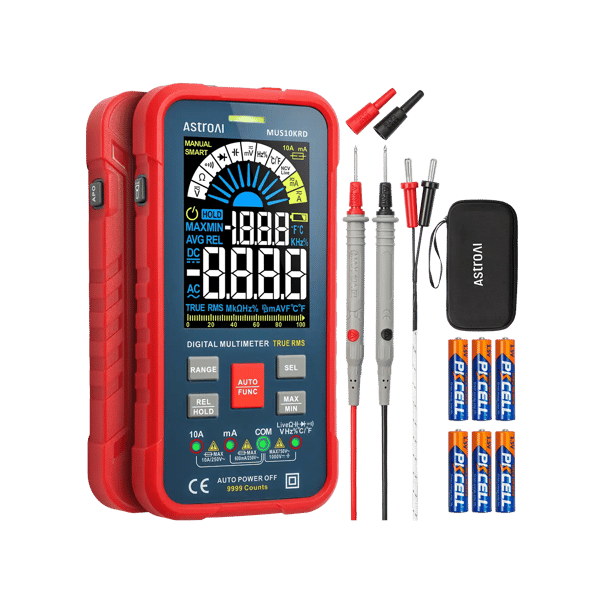
Best for EV / Hybrid Owners & Technicians
AstroAI MUS10KRD — 10000 Counts, True-RMS, Low-Z
EV and plug-in hybrid owners face two unique diagnostic challenges: high-voltage traction battery systems (400V–800V range) and ghost voltages induced by DC-DC converters. The MUS10KRD's Low-Z (LoZ) mode bleeds off stray capacitive voltages that can mislead cheaper meters — giving you a true zero reading on unpowered circuits rather than a phantom 50V or 80V that triggers false alarms. Its 10000-count display at DC 1000V resolves to 0.0001V on the 1V range and 0.1V on the 1000V range — sufficient for measuring 400V battery pack voltage with meaningful precision. The VFC/LPF (variable frequency drive filter) further suppresses electrical noise on modern powertrain sensors.
- 10000 counts · True-RMS · DC 1000V · AC 750V
- Low-Z (LoZ) · VFC/LPF · NCV · Frequency 100 Hz – 10 MHz
- Flashlight · Min/Max Hold · Auto + Manual ranging · Duty cycle
- Designed for professional-level EV and hybrid diagnostics
Budget note: the AstroAI AM33D (2000 counts, DC 600V) is the most affordable option and handles basic static voltage and alternator tests. Named "Best Budget" by Popular Mechanics (Jun 2025). It lacks True-RMS and the finer resolution of the DT132A, so it is best suited for straightforward battery checks on conventional (non-hybrid) vehicles.
The Bottom Line
Three measurements — resting voltage, cranking voltage, and charging voltage — give you a complete picture of your car's electrical health in under ten minutes. A healthy 12V lead-acid battery reads 12.6V or above at rest, holds 10.0V or above during cranking, and sees 13.8–14.7V from a working alternator. Any reading outside these ranges tells you exactly what to address next, before a roadside breakdown makes the decision for you. The AstroAI DT132A is the ideal starting point: True-RMS, 4000-count precision, and a built-in flashlight for under-hood work — all at an accessible price. For smart-alternator vehicles or professional diagnostics, step up to the DM6000AR or MUS10KRD.
Compare All AstroAI Multimeters →Frequently Asked Questions
What voltage should a car battery read when fully charged?
A fully charged 12V lead-acid car battery reads 12.6V or above with the engine off and the battery at rest for at least 30 minutes. A reading of 12.4V indicates roughly 75% charge — still functional but worth monitoring. Below 12.0V the battery is severely discharged and may not reliably start the engine. These reference values are consistent across Haynes Manuals (Feb 2025), CarParts.com (Apr 2025), and Black Circles (Sep 2025).
What should a car battery read while the engine is running?
With the engine running, your multimeter should read 13.8–14.7V at the battery terminals. This higher voltage confirms the alternator is actively charging the battery. If the reading stays below 13.5V, the alternator may be underperforming — recheck at higher RPM (~2,000 RPM). If the reading exceeds 15.0V, the voltage regulator may be faulty and causing overcharging (Mestek Instruments, Nov 2025).
Can I test a car battery and alternator with a cheap multimeter?
Yes — a basic 2000-count DC voltmeter costing under $20 can perform the static voltage and alternator tests described above. It will read in 0.1V increments, which is sufficient for a pass/fail diagnosis. However, if your vehicle has a smart alternator (start-stop system, mild hybrid), a True-RMS meter like the AstroAI DT132A or DM6000AR gives more reliable readings because those systems pulse the charge voltage rather than delivering a steady DC output. A 4000-count meter also lets you detect whether a battery is at 12.43V versus 12.37V — a distinction that is invisible to a 2000-count meter.
How do I know if my alternator is bad or my battery is bad?
The key is to compare the engine-off voltage with the engine-running voltage. If the battery reads low at rest (below 12.4V) but the engine-running voltage is normal (13.8–14.7V), the alternator is fine — the battery is failing to hold charge between drives. If the running voltage stays close to or below the resting voltage (for example, 12.5–13.0V while running), the alternator is not charging — the battery is powering the vehicle. FridayParts' 3-step DIY test (Dec 2025) and AutoZone's charging-system guide both use this same before/after comparison as the definitive diagnostic.
Do I need to disconnect the battery to test it with a multimeter?
No — all three tests in this guide are performed with the battery connected to the vehicle. You measure across the battery terminals from outside with the probes. Disconnecting the battery is only required for certain battery-replacement procedures, not for voltage testing. In fact, leaving the battery connected is essential for the cranking test (Step 2) and the alternator test (Step 3), which require the car's electrical system to be active.
How often should I test my car battery with a multimeter?
Most experts recommend a quick voltage check every three months and always before a long road trip or at the start of winter. AAA data shows car batteries typically last 3–5 years, with failure rates rising sharply after year three — particularly in climates with temperature extremes. A monthly 5-minute check lets you spot a battery declining from 12.6V toward 12.2V over several weeks, giving you time to replace it on your schedule rather than when it fails to start on a cold morning.
Sources
- Haynes Manuals — "How to Test a Car Battery with a Multimeter," Feb 16, 2025. us.haynes.com
- CarParts.com — "Step-by-Step Guide on How to Test a Car Battery," Apr 29, 2025. carparts.com
- Black Circles — "How to Check Car Battery with a Multimeter," Sep 12, 2025. blackcircles.com
- Continental Battery — "How to Test Your Car Battery: A Step-by-Step Guide," Feb 4, 2025. continentalbattery.com
- AutoZone DIY — "How to Test a Car Battery with a Multimeter," updated 2025. autozone.com
- Mestek Instruments — "How to Test an Alternator with a Multimeter," Nov 14, 2025. mestekinstruments.com
- CarParts.com — "How to Test an Alternator: A Clear, Hands-on Walkthrough," Oct 16, 2025. carparts.com
- FridayParts — "How to Test an Alternator with a Multimeter," Dec 1, 2025. fridayparts.com
- AutoZone DIY — "How to Test the Alternator and Charging System," updated 2025. autozone.com
- ToolTroopers — "The #1 Cause of Vehicle Breakdowns (2026)," Apr 7, 2026. tooltroopers.com
- AAA — "How Long Do Car Batteries Last," 2025. aaa.com
- Expert Reviews UK — "Best Multimeter — Tried, Tested, Reviewed," Nov 2024. expertreviews.co.uk
- Popular Mechanics — "The 7 Best Multimeters for Reliable Electrical Measurements," Jun 2025. popularmechanics.com