Best Tire Inflator for SUV and Truck Tires
July 21st , 2026 | AstroAI *
SUV & Light-Truck Tire Care • Portable Air Compressors • Buying Guide
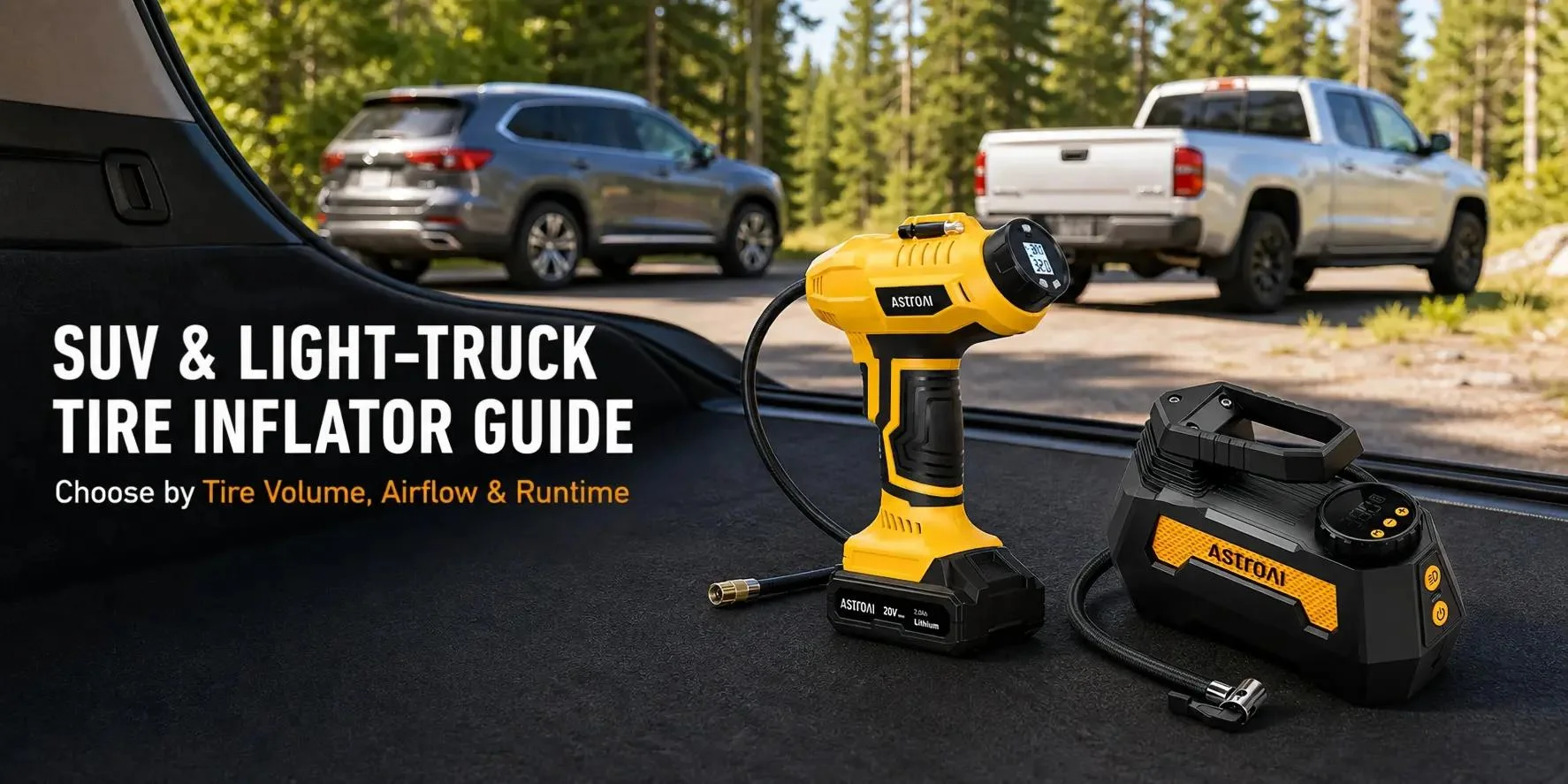
Best Tire Inflator for SUV and Truck Tires
The best tire inflator for an SUV or truck depends more on tire volume, airflow, operating time, and power source than on maximum PSI alone. For SUVs and crossovers, AstroAI C2 combines 22 L/min airflow, 160 PSI capability, a rechargeable battery, and 12V DC backup. For routine pressure top-offs on many light-duty pickup tires, AstroAI H2 Pro is the stronger fit of these two because it provides 23 L/min airflow and up to 60 minutes of operation in DC mode.
Quick Answer
Choose AstroAI C2 for SUV, crossover, passenger-car, motorcycle, and bicycle tire maintenance when a removable rechargeable battery and 12V backup are priorities.
Choose AstroAI H2 Pro for SUV and light-duty pickup top-offs when slightly higher airflow, compact storage, and longer DC operating time matter more.
Choose a heavy-duty high-flow compressor instead for large LT tires, dual rear wheels, commercial trucks, RVs, oversized off-road tires, airing up from very low pressure, or repeated multi-tire work.
Neither compact inflator should be treated as a commercial-truck compressor. The C2 manual specifically says it is not suitable for trucks, RVs, or other large-volume objects. H2 Pro is better reserved for modest top-offs on compatible SUVs and light-duty pickups, not repeated inflation of large LT, dually, commercial, RV, or oversized off-road tires.
Start With Tire Volume, Not Maximum PSI
A compact pump can advertise 150 or 160 PSI and still take a long time to move enough air into a large tire. Maximum pressure describes the upper pressure limit. Airflow describes how much air the pump moves, while operating time indicates how long it can continue before its manual requires a stop or the unit reaches a thermal limit. SUV and pickup owners need to consider all three.
A small pressure correction, such as restoring a tire that is a few PSI low, is a much easier job than inflating a nearly flat high-volume tire. This guide therefore separates routine top-offs from flat fills, off-road air-ups, and heavy-duty service. That distinction is more useful than assuming every product labeled 150 PSI is equally suited to truck tires.
What “Truck Tires” Means in This Guide
Here, truck use means routine pressure maintenance on compatible light-duty pickups. It does not mean commercial trucks, medium-duty vehicles, dual rear wheels, large RV tires, or oversized off-road tires. Always compare the inflator manual with the tire size, required pressure, number of tires, and intended starting pressure.
What Matters in an SUV or Light-Truck Tire Inflator?
The right inflator should reach every tire, deliver enough air for the job, and remain within its stated operating limits. Compare these factors before choosing by PSI alone.
Airflow
Airflow in L/min or CFM helps indicate how quickly the pump can fill a larger-volume tire. C2 is listed at 22 L/min and H2 Pro at 23 L/min.
Operating time
Longer jobs generate heat. C2 allows up to 20 minutes of continuous operation; H2 Pro lists up to 60 minutes in DC mode and 18 minutes of battery operation.
Power source
Battery mode is convenient for quick checks. A 12V DC connection provides a useful backup for longer sessions when the vehicle outlet meets the product requirements.
Hose and cord reach
Longer vehicles need enough reach for rear tires. Check hose length, 12V cable length, connector position, and whether the cord can be routed safely.
Preset and auto shut-off
A digital preset helps you target the vehicle placard pressure, and auto shut-off reduces constant monitoring. Recheck the finished pressure before driving.
Tire condition
An inflator adds air; it does not repair a puncture, damaged sidewall, bulge, cracked valve, or wheel problem. Stop if the tire is visibly unsafe.
AstroAI Tire Inflator Recommendations
C2 and H2 Pro are both dual-power portable inflators, but they serve different priorities. C2 is the more tool-like cordless option for SUV and general household use. H2 Pro is the more compact choice for SUV and light-duty pickup top-offs when longer 12V operation matters.
Best for cordless SUV convenience
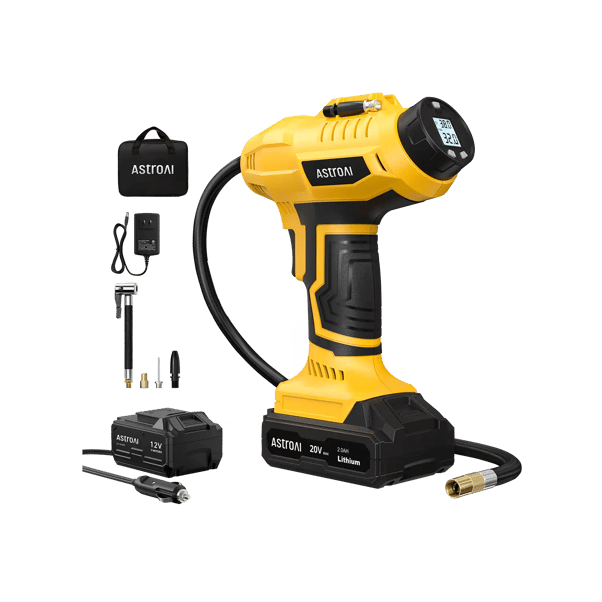
AstroAI C2 Handheld Cordless Tire Inflator
Best for: SUV and crossover owners who want a removable rechargeable battery, familiar handheld controls, and 12V backup power.
- 160 PSI maximum working pressure
- 22 L/min listed airflow
- 12V DC or 18V 2.0Ah rechargeable battery pack
- Up to 20 minutes continuous operation, followed by cooling
- 19.7 in (50 cm) hose and 9.84 ft (3 m) DC cable
- Digital preset, pressure display, and automatic shut-off
Pros: Removable battery, dual power, compact storage, and enough flexibility for several household inflatables.
Cons: Its 22 L/min airflow is still compact-pump territory, and long high-volume fills can be slow.
Skip it if: You are shopping specifically for truck, RV, commercial, or other large-volume tire inflation; the C2 manual excludes those uses.
View AstroAI C2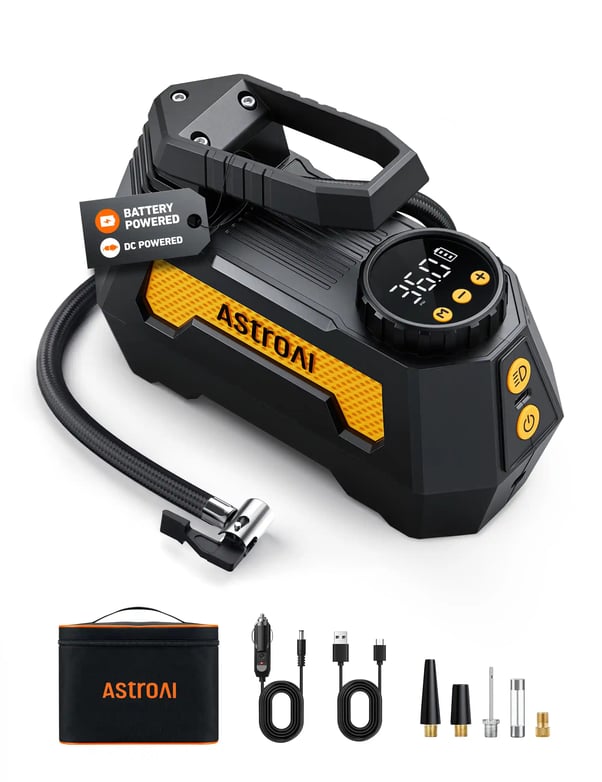
Better fit for light-truck top-offs
AstroAI H2 Pro Tire Inflator
Best for: SUV and light-duty pickup owners making routine pressure corrections who want compact storage plus extended 12V operating time.
- 150 PSI maximum working pressure
- 23 L/min listed airflow
- 12V DC and lithium-battery power options
- Up to 60 minutes in DC mode; 18-minute listed battery life
- 1.8 ft (0.55 m) hose and 9.8 ft (3 m) power cord
- Four pressure units, digital preset, and automatic shut-off
Pros: Slightly higher airflow than C2, longer DC-mode operating time, integrated storage, and compact form.
Cons: It is still a portable 23 L/min pump, so large-volume tires can require patience and cooling awareness.
Skip it if: You need repeated flat fills, rapid off-road air-ups, dually access, RV service, or commercial-truck duty.
View AstroAI H2 ProC2 vs. H2 Pro: SUV and Light-Truck Comparison
| Feature | AstroAI C2 | AstroAI H2 Pro | Why It Matters |
|---|---|---|---|
| Maximum pressure | 160 PSI | 150 PSI | Both exceed typical top-off targets; PSI alone does not indicate fill speed. |
| Listed airflow | 22 L/min | 23 L/min | H2 Pro has a modest airflow advantage, not a heavy-duty-compressor gap. |
| Power | Rechargeable battery pack + 12V DC | Internal lithium battery + 12V DC | Both offer cordless convenience with a vehicle-power backup. |
| Operating window | 20-minute maximum continuous use | Up to 60 minutes in DC mode; 18 minutes on battery | H2 Pro is better aligned with repeated modest corrections when DC power is available. |
| Hose / cord | 19.7 in hose / 9.84 ft DC cable | 1.8 ft hose / 9.8 ft power cord | Confirm reach to every valve before relying on DC mode. |
| Best fit | SUVs, crossovers, cars, motorcycles, bicycles | SUVs and compatible light-duty pickup top-offs | Neither replaces a high-flow compressor for large-volume or commercial use. |
Best Inflator by Vehicle and Tire Scenario
Vehicle labels are only a starting point. Tire size, required cold pressure, the amount of pressure lost, and the number of tires determine how demanding the job will be.
| Scenario | Recommended Direction | Reason |
|---|---|---|
| Crossover or midsize SUV, a few PSI low | C2 or H2 Pro | Both are designed for portable top-offs; choose by preferred battery format and storage. |
| Light-duty pickup, modest pressure correction | H2 Pro in 12V DC mode | 23 L/min airflow and longer listed DC operation provide more useful margin. |
| Nearly flat SUV or pickup tire | Inspect first; use service or a higher-flow compressor when needed | A rapid pressure loss may indicate damage, and a full fill is a much larger thermal load. |
| Oversized off-road tires after airing down | High-flow heavy-duty compressor | Repeated high-volume fills require more airflow and thermal capacity. |
| Dually, RV, medium-duty or commercial truck | Purpose-built heavy-duty system | Pressure, volume, reach, valve access, and repeated duty exceed the intended compact-pump role. |
Why C2 Is the Better Cordless Choice for SUVs
C2 makes sense when the most common job is walking around an SUV, checking four tires, and correcting small pressure differences without routing a power cord. Its removable 18V 2.0Ah battery pack supports cordless work, while the 12V adapter gives you a backup if the battery charge is low.
The handheld shape also works well for mixed household use: passenger cars, motorcycles, bicycles, and small inflatables. The tradeoff is operating scope. The manual limits continuous use to 20 minutes and explicitly excludes trucks, RVs, and other large-volume objects. That makes C2 a strong SUV tool, not a general answer for every vehicle called a truck.
Why H2 Pro Fits Light-Duty Pickup Top-Offs Better
H2 Pro moves a listed 23 L/min, slightly more than C2, but its more meaningful advantage for pickup owners is the listed maximum of 60 minutes in DC mode. That provides additional operating margin for checking multiple larger tires when the vehicle's 12V outlet is available and compatible.
Use that advantage for maintenance, not as permission to attempt every tire. Its battery life is listed at 18 minutes, and the manual advises cooling the pump if excessive use slows inflation. For a full-size pickup with large LT tires, a long pressure recovery, repeated campsite use, or off-road air-up duties, choose a compressor designed around higher airflow and heavier duty.
Do Not Inflate to the Tire Sidewall Maximum
Use the vehicle manufacturer's recommended cold pressure on the driver-side door placard or in the owner's manual. The pressure molded into the tire sidewall is not the normal target pressure for the vehicle.
How to Inflate SUV or Light-Truck Tires Safely
The same basic method applies to both products. Follow the vehicle manual and the inflator manual whenever their instructions are more specific.
-
1Check the tire while cold. For the most useful baseline, measure before driving or after the vehicle has been parked long enough for the tires to cool.
-
2Find the vehicle's target pressure. Use the door placard or owner's manual, including any different front, rear, loaded, or towing recommendation.
-
3Inspect the tire and valve. Do not inflate a tire with a bulge, exposed cord, severe cut, damaged valve, separated tread, or other unsafe condition.
-
4Choose battery or 12V power. Confirm adequate charge, or connect the 12V cable exactly as directed and verify the vehicle outlet meets the inflator requirements.
-
5Attach the hose securely. Seat the connector squarely on the valve stem and check for an obvious leak before starting.
-
6Set the placard pressure. Select the correct unit, enter the recommended cold pressure, and confirm the preset is above the tire's current pressure.
-
7Inflate and monitor the pump. Let auto shut-off stop at the preset, but stop sooner if the unit becomes abnormally hot, changes sound, slows sharply, or the tire behaves unexpectedly.
-
8Disconnect, verify, and diagnose losses. Remove the connector, reinstall the valve cap, verify pressure, and arrange tire service if pressure drops again.
What to Do When the TPMS Light Comes On
A TPMS warning means at least one monitored tire may be significantly underinflated; it does not identify whether the cause is normal pressure loss, temperature change, a puncture, valve leakage, or tire damage. Move to a safe location, inspect the tires, and measure each tire rather than adding air blindly.
If the tire appears structurally sound and only needs a modest correction, inflate it to the vehicle placard value. If it is rapidly losing air, visibly damaged, extremely low, or unable to hold pressure after inflation, do not rely on the pump as a repair. Use the spare, roadside support, or professional tire service as appropriate.
Common Buying and Use Mistakes
| Mistake | Why It Matters | Better Approach |
|---|---|---|
| Choosing by max PSI only | High pressure does not guarantee high airflow or long duty. | Compare airflow, operating time, power, and tire volume. |
| Inflating to sidewall PSI | The sidewall value is not the vehicle's normal target. | Use the vehicle placard or owner's manual. |
| Treating a pump as a tire repair | Air can escape again, and hidden damage can remain unsafe. | Investigate recurring pressure loss and repair the cause. |
| Ignoring heat and runtime limits | Compact compressors generate substantial heat. | Observe the manual's operating and cooling instructions. |
| Leaving the battery uncharged | Cordless convenience disappears when the pack is empty. | Charge before travel and keep the 12V cable with the unit. |
Storage and Readiness Checklist
- Charge the inflator before a long trip and after cordless use.
- Store the hose, 12V cable, valve adapters, fuse, and manual together.
- Keep the unit dry and within the storage-temperature guidance in its manual.
- Test the display and confirm the hose reaches every tire before an emergency.
- Keep a separate tire pressure gauge for quick checks and verification.
- Inspect tires monthly and before long trips, including the spare when equipped.
Bottom Line
For SUV owners, AstroAI C2 is the more flexible cordless choice when the job is regular pressure maintenance and portable household use. For compatible light-duty pickups, AstroAI H2 Pro is the better of these two for modest top-offs because its 23 L/min airflow and longer DC-mode operating window provide more useful margin.
For large LT tires, dual rear wheels, commercial trucks, RVs, oversized off-road tires, or frequent from-low-pressure inflation, move up to a purpose-built high-flow compressor. The best tire inflator is not the one with the highest PSI printed on the box; it is the one whose airflow, duty, reach, and intended use match the tire in front of you.
Frequently Asked Questions
What is the best tire inflator for an SUV?
AstroAI C2 is the better cordless SUV choice when portability and a removable battery matter. H2 Pro is also suitable for SUV top-offs and provides slightly higher airflow plus longer DC-mode operation.
What is the best tire inflator for truck tires?
For modest pressure corrections on compatible light-duty pickup tires, H2 Pro is the better of these two because it lists 23 L/min airflow and up to 60 minutes in DC mode. Use a high-flow heavy-duty compressor for large LT, dually, RV, off-road, or commercial-truck tires.
Can AstroAI C2 inflate truck tires?
C2 should not be selected for truck or RV tire inflation. Its manual identifies SUVs, cars, motorcycles, bicycles, and small inflatables as suitable uses and explicitly excludes trucks, RVs, and other large-volume objects.
Can H2 Pro inflate a light-truck tire?
H2 Pro can be considered for modest top-offs on compatible light-duty pickup tires. Confirm the tire size and pressure, use 12V mode for longer work, and choose a heavier-duty compressor for large-volume or repeated inflation.
Is 150 PSI enough for SUV and truck tires?
Maximum PSI is only one requirement. A 150 PSI pump can reach many target pressures, but airflow, tire volume, operating time, power, and product suitability determine whether the job is practical.
Which matters more for truck tires, PSI or airflow?
Both matter, but airflow becomes especially important as tire volume increases. The pump must reach the required pressure and move enough air without exceeding its duty and thermal limits.
Should I use battery or 12V power for SUV tires?
Battery power is convenient for quick top-offs. Use compatible 12V power when the battery is low or the job may take longer, following the inflator and vehicle instructions.
What pressure should I use for SUV or pickup tires?
Use the vehicle manufacturer's recommended cold pressure on the driver-side door placard or in the owner's manual. Do not use the maximum pressure printed on the tire sidewall as the normal target.
Can a tire inflator fix a puncture?
No. A tire inflator only adds air. A puncture, valve leak, sidewall damage, bead leak, or wheel problem needs proper inspection and repair.
How often should SUV and truck tire pressure be checked?
Check all tires, including the spare when equipped, at least once a month while cold and before long trips. Inspect sooner after a TPMS warning, curb strike, pothole impact, or visible pressure loss.