Beginner Buying Guide • Digital Multimeters • 2026
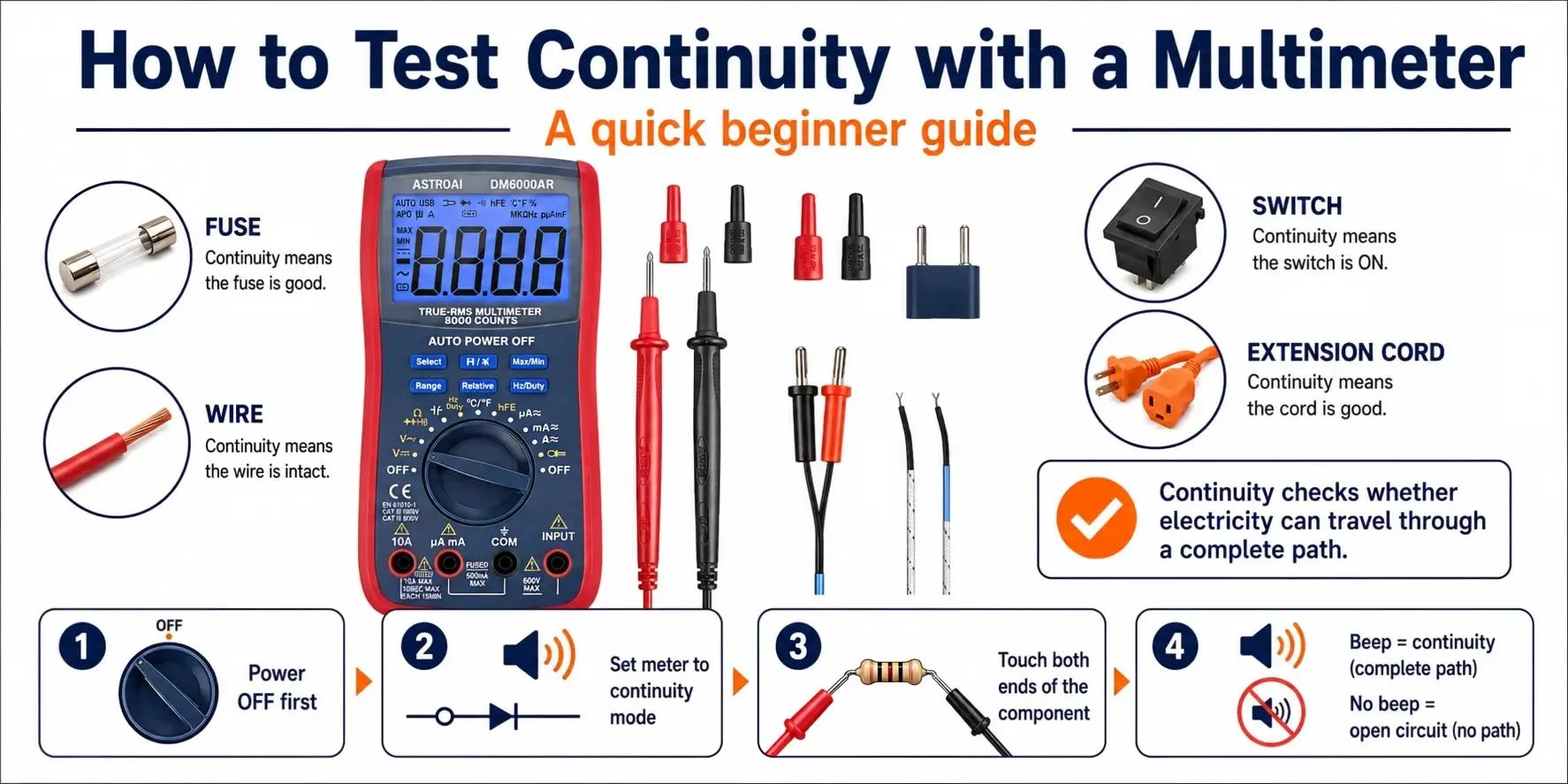
Best Multimeter for Beginners in 2026
The best first multimeter is not necessarily the model with the most modes. It is the meter whose range selection, display, probe layout, and measurement functions match what you plan to learn. For most beginners, the AstroAI DM130B is the most balanced starting point because it combines a 4000-count display, automatic and manual ranging, core electrical measurements, capacitance, NCV screening, and dedicated 1.5V/9V/12V battery test positions. The AstroAI AM33B is a simpler budget choice for learning manual ranges and checking basic DC voltage, resistance, continuity, and diodes. The AstroAI DM6000AR gives growing hobbyists more measurement range and functions.
Is a budget multimeter enough for car battery checks? Yes, if your goal is to read the DC voltage at a 12V battery's terminals. However, that reading alone does not measure cold-cranking capability, apply a load test, or prove that the battery and charging system are healthy.
Quick Answer: Which Beginner Multimeter Should You Choose?
- Choose the AM33B if you want a low-cost meter for classroom basics, hobby circuits, household batteries, continuity, and simple car battery voltage checks.
- Choose the DM130B if you want auto-ranging convenience, a larger 4000-count display, capacitance, NCV screening, and dedicated battery test positions.
- Choose the DM6000AR if you expect to progress into frequency, duty-cycle, temperature, and wider-range electronics work.
Beginner Safety Boundary
Start with low-voltage batteries and de-energized circuits. Do not test wall outlets, service panels, EV high-voltage systems, or other mains circuits unless you are trained and are using equipment and probes correctly rated for that environment. Never measure resistance, continuity, diode condition, or capacitance on an energized circuit. NCV is a preliminary screening function, not proof that a circuit is de-energized. NIOSH electrical-safety guidance emphasizes de-energizing circuits before work and assigning energized electrical work to qualified people.
AstroAI Recommendations
Three Sensible Starting Points, Based on What You Want to Learn
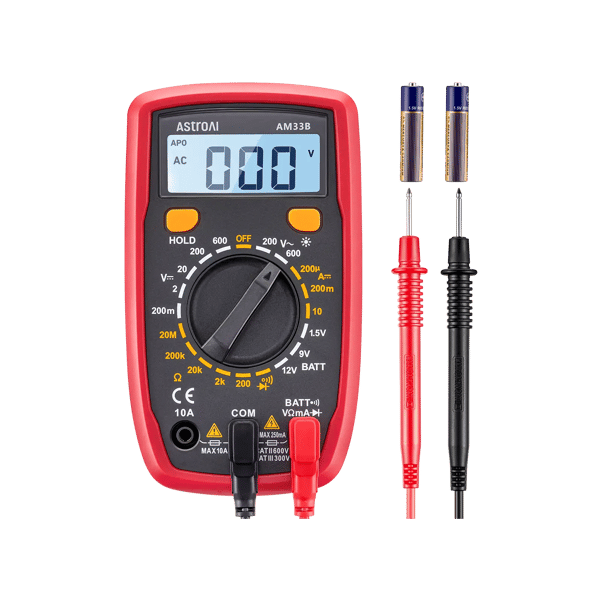
BEST BUDGET STARTER
AstroAI AM33B - 2000-Count Manual-Range Multimeter
Verified summary: A 2000-count manual-range meter for learning voltage, resistance, continuity, diode testing, and basic DC current measurement.
Best for: First electronics exercises, household batteries, fuses, wire continuity, resistor checks, and basic 12V car battery voltage readings.
Not best for: Users who do not want to choose ranges manually or who need capacitance, frequency, temperature, or NCV screening.
- Manual range selection teaches how measurement ranges work.
- Core functions cover many beginner lessons.
- Simple dial keeps the first-use learning curve manageable.
Tradeoff: Manual range selection takes an extra step and requires the user to start high when the expected value is unknown.
View AstroAI AM33B
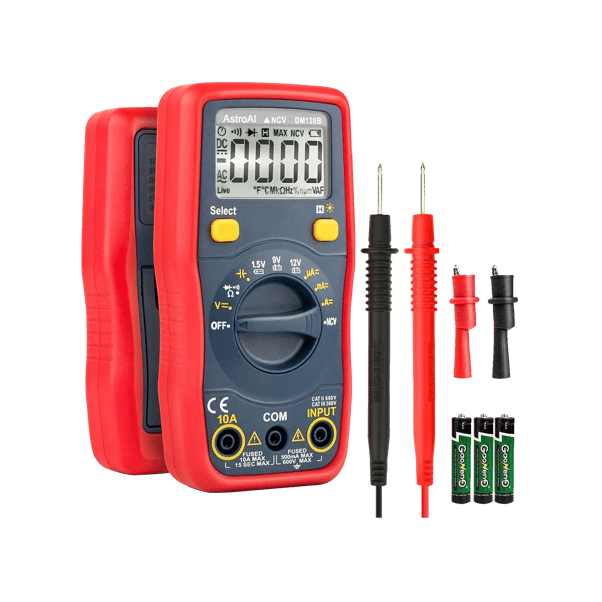
BEST BALANCED FIRST METER
AstroAI DM130B - 4000-Count Auto/Manual Multimeter
Verified summary: A 4000-count digital multimeter with manual and auto range selection, AC/DC voltage and current, resistance, continuity, capacitance, NCV, and dedicated 1.5V/9V/12V battery testing.
Best for: Beginners who want a meter that is easy on day one but still useful for mixed electronics, batteries, basic automotive checks, and household troubleshooting.
Not best for: Users who specifically need frequency, temperature, or higher display counts.
- Auto-ranging reduces dial decisions during basic measurements.
- Manual ranging remains available for structured lessons.
- Dedicated battery positions make common battery checks easier to organize.
Tradeoff: NCV can help screen for electric fields, but it cannot confirm that conductors are safe to touch.
View AstroAI DM130B
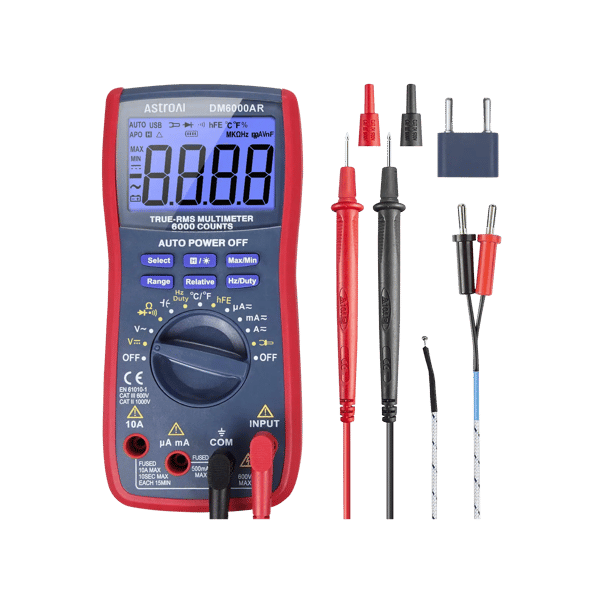
BEST FOR ROOM TO GROW
AstroAI DM6000AR - 6000-Count Multimeter
Verified summary: A 6000-count digital multimeter with manual and auto range selection, AC/DC voltage and current, resistance, continuity, diode, capacitance, frequency, duty cycle, and temperature measurement.
Best for: Learners who expect to progress beyond first circuits into appliance components, sensors, frequency signals, temperature, and broader bench work.
Not best for: Users who want the fewest possible controls or who specifically require NCV, LoZ, VFD/VFC/LPF, or hFE transistor testing.
- 6000-count display offers finer display increments than 2000-count models.
- Frequency, duty-cycle, and temperature add useful learning paths.
- Auto and manual range selection support convenience and instruction.
Tradeoff: More functions create more symbols and mode choices to learn.
View AstroAI DM6000AR
Beginner Multimeter Comparison
The useful difference is not simply 2000 versus 4000 versus 6000 counts. It is how much the meter asks you to configure, which measurements it supports, and how long it can stay relevant as your projects become more complex.
| Feature |
AM33B |
DM130B |
DM6000AR |
| Maximum display | 2000 counts | 4000 counts | 6000 counts |
|---|
| Range selection | Manual | Auto and manual | Auto and manual |
|---|
| Core voltage and resistance checks | Yes | Yes | Yes |
|---|
| Continuity and diode test | Yes | Yes | Yes |
|---|
| Capacitance | No | Yes | Yes |
|---|
| Frequency and duty cycle | No | No | Yes |
|---|
| Temperature | No | No | Yes |
|---|
| NCV screening | No | Yes | No |
|---|
| Best beginner fit | Manual-range learning and simple checks | Convenient all-around first meter | Longer-term hobby and bench growth |
|---|
How Do I Choose My First Multimeter?
Choose by the work you will actually do during the next year. A beginner meter should make common measurements clear and repeatable before it adds specialized modes. Use the six checks below to separate useful capability from feature overload.
1. Decide between auto-ranging and manual ranging
Auto-ranging is easier for most first-time users. Select the measurement type and the meter chooses an appropriate range. Manual ranging is useful for structured learning and can provide more deliberate control, but the user must select a range above the expected value. A meter with both modes, such as the DM130B or DM6000AR, supports both approaches.
2. Treat display counts as resolution, not overall quality
Counts indicate how many values the display can represent before changing range. More counts can show smaller changes within a range, but they do not automatically make a meter safer, more accurate, or easier to use. A 2000-count meter is enough for many battery and continuity checks; 4000 or 6000 counts become more useful when you want finer display steps or a broader project range.
3. Prioritize the core functions first
For a first meter, prioritize DC voltage, AC voltage, resistance, continuity, and diode test. DC current can be useful, but current measurement has a different connection method and a higher risk of blowing the meter fuse when the lead is in the wrong jack. Capacitance, frequency, duty cycle, and temperature are valuable only when your planned projects need them.
4. Check the jack layout and fuse protection
A clear COM jack, a clearly marked voltage/resistance jack, and separately labeled current jacks reduce setup mistakes. Before every measurement, confirm both the dial position and red-lead jack. After measuring current, return the red lead to the voltage/resistance jack so the next voltage check does not accidentally short a source.
5. Match the safety category to the environment
A printed CAT rating, voltage limit, and probe rating describe specific measurement environments and transient exposure. They are not a general permission to probe any circuit. Beginners should build skill on low-voltage sources and de-energized components. For mains work, training, procedures, protective equipment, and the complete measurement setup all matter.
6. Buy for the measurements you can explain
If you cannot yet explain what a mode measures, how the meter connects, and whether the circuit must be powered, that mode should not drive the purchase. A useful first meter is one you can set up correctly without guessing. Add specialized capability when your projects create a real need for it.
Match the Meter to the Beginner Scenario
| Scenario | What matters most | Good starting fit | What not to overbuy |
|---|
| First electronics class | Manual range practice, voltage, resistance, continuity, diode test | AM33B | Specialized signal modes |
| General DIY and household troubleshooting | Auto-ranging, continuity, capacitance, clear display | DM130B | High-count display without a matching use case |
| Basic car battery voltage checks | DC voltage range above 15V, readable display, correct probe setup | AM33B or DM130B | Temperature and frequency modes |
| Growing electronics hobby | More counts, capacitance, frequency, duty cycle | DM6000AR | Features unrelated to planned projects |
| Automotive parasitic-draw diagnosis | Current limits, fused inputs, series connection, vehicle sleep behavior | Training first; model choice second | Assuming a voltage check is a full diagnosis |
Is a Budget Multimeter Enough for Car Battery Checks?
Yes for basic terminal-voltage checks; no for a complete battery-health diagnosis. A budget digital multimeter can show the DC voltage present at a conventional 12V battery's terminals. This is useful for comparing a resting reading with the vehicle or battery manufacturer's guidance and for noticing an obvious low-voltage condition.
A terminal-voltage reading does not directly measure available cranking current or battery capacity. It also does not apply a controlled load, identify an internal battery defect, or isolate every charging-system problem. A battery can display plausible open-circuit voltage and still perform poorly under load.
A budget meter can help with
- 12V battery terminal voltage
- Small household battery voltage
- De-energized fuse and wire continuity
- Basic resistance and diode exercises
A voltage reading cannot replace
- A battery load or conductance test
- A cold-cranking-amp evaluation
- A complete starting and charging-system diagnosis
- Correct parasitic-current test procedure
How to Check a 12V Car Battery with a Beginner Multimeter
This procedure is limited to a basic DC terminal-voltage check on a conventional accessible 12V battery. Follow the vehicle manual, keep tools away from moving or hot parts, and do not probe hybrid or EV high-voltage components.
- Park safely and turn the vehicle off. Set the parking brake, remove loose jewelry, and keep the test leads clear of belts, fans, and hot surfaces.
- Inspect the meter and test leads. Do not use cracked leads, exposed conductors, a damaged case, or a meter with an unclear display.
- Connect the leads for voltage. Insert the black lead into COM and the red lead into the voltage/resistance input, not a current jack.
- Select DC voltage. On an auto-ranging meter, select DC volts. On a manual meter, select a DC range above 15V, such as the 20V range when available.
- Touch the probes to the battery terminals. Place the red probe on the positive terminal and the black probe on the negative terminal without allowing the probe tips to touch each other.
- Read the display. Note the voltage and compare it with the battery or vehicle manufacturer's instructions, considering whether the battery was recently charged or the vehicle was recently driven.
- Interpret the result conservatively. Treat the reading as a voltage snapshot, not a complete judgment of battery capacity, cranking performance, or charging-system health.
- Remove the probes and switch the meter off. Remove the black probe and red probe without bridging terminals, then store the leads in the normal voltage configuration.
Seven Beginner Mistakes to Avoid
- Leaving the red lead in the current jack. This can create a short when the next measurement is voltage.
- Measuring current across a battery. Current is measured in series, not in parallel across a power source.
- Using continuity on a powered circuit. De-energize first and discharge stored energy.
- Starting a manual-range test too low. When the value is unknown, begin with a higher compatible range and step down.
- Confusing AC and DC voltage. Conventional vehicle and portable batteries are DC; building supply lines are AC.
- Treating NCV as a safety confirmation. Detection can vary with shielding, distance, orientation, and field strength.
- Buying advanced modes without learning the input jacks. Correct lead placement matters before display count or extra functions.
Final Recommendation
For most first-time buyers, the DM130B offers the easiest balance of simplicity and useful range. Auto-ranging lowers setup friction, while manual ranging remains available when you want to learn range selection. The battery test positions, capacitance, continuity, and NCV screening broaden the projects it can support.
Choose the AM33B when budget and basic learning are the priority. Choose the DM6000AR when you already know that frequency, duty cycle, temperature, and higher display counts will be part of your next projects. Whichever model you choose, correct probe placement and measurement procedure matter more than the number of modes on the dial.
Frequently Asked Questions
What is the best multimeter for a complete beginner?
For most beginners, a 4000-count auto-ranging meter with voltage, resistance, continuity, diode, and fused current inputs is a balanced choice. The AstroAI DM130B adds manual ranging, capacitance, NCV screening, and dedicated battery test positions without requiring a highly specialized workflow.
Is a cheap multimeter enough for checking a car battery?
Yes, a basic meter that supports a DC voltage range above 15V is enough to read a conventional 12V battery's terminal voltage. It cannot replace a load test, cold-cranking evaluation, or complete starting and charging-system diagnosis.
Should a beginner buy an auto-ranging multimeter?
Auto-ranging is usually easier because the meter selects the measurement range after you choose the function. A model that also offers manual ranging is useful when a class or project requires deliberate range selection.
Are 2000 counts enough for a first multimeter?
Yes, 2000 counts are enough for many basic battery, continuity, resistance, and diode checks. Higher counts can show finer display increments, but counts alone do not determine safety, accuracy, or ease of use.
Do beginners need True RMS?
Not for every beginner task. Basic DC battery checks, resistance, and continuity do not depend on True RMS; it becomes more relevant when measuring certain non-sinusoidal AC waveforms. Choose it when your planned AC work requires it rather than as a substitute for correct technique.
Can I use a beginner multimeter on a wall outlet?
A beginner should not test wall outlets or electrical panels without appropriate training. Mains measurements require a correctly rated meter, correctly rated probes, proper procedures, and an understanding of the installation and transient hazards.
What functions should my first multimeter have?
Prioritize DC voltage, AC voltage, resistance, continuity, diode test, a readable display, clear jacks, and fused current inputs. Add capacitance, frequency, duty cycle, temperature, or NCV only when they match your projects.
Why does my multimeter show a negative car battery voltage?
A negative sign usually means the probes are reversed: the red probe is on the negative terminal and the black probe is on the positive terminal. Reconnect red to positive and black to negative without letting the probe tips touch each other.
Can a multimeter test whether a car battery is healthy?
A multimeter can provide a useful voltage snapshot, but voltage alone cannot establish battery capacity or cranking performance. A complete assessment may require a controlled load or conductance test and checks of the starting and charging system.
What should I test first when learning to use a multimeter?
Start with a low-voltage household battery, then practice continuity on a disconnected wire or fuse and resistance on a de-energized resistor. These exercises teach probe placement, polarity, display reading, and range selection without starting on mains circuits.
References and Product Details