Why Every Driver Needs a Jump Starter This Summer
July 16th , 2026 | AstroAI *
Summer Driving • Battery Emergencies • Road Trip Preparation
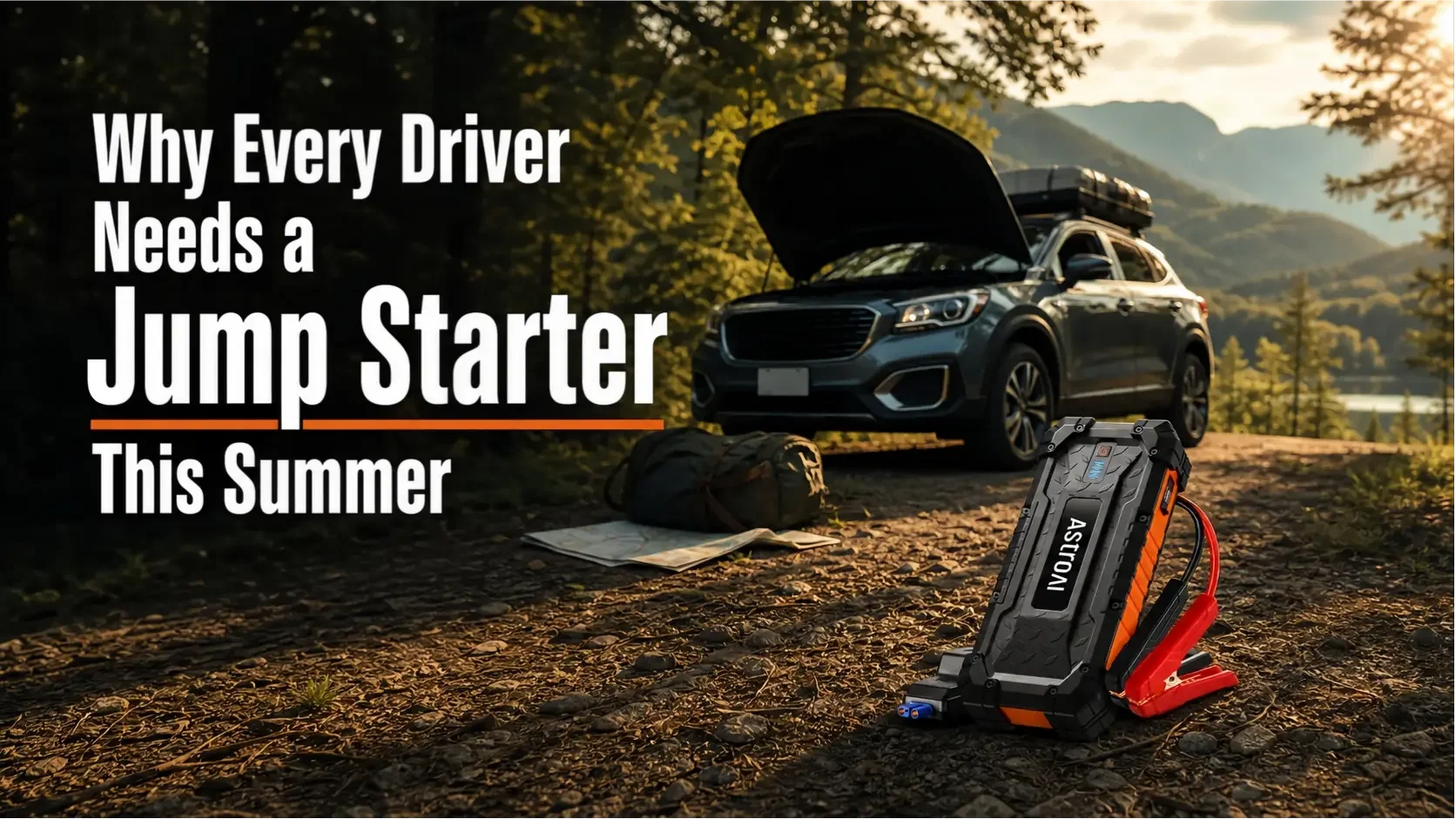
Why Every Driver Needs a Jump Starter This Summer
Summer heat, long parking periods, accessory use, and road-trip mileage can expose a weak 12V battery with little warning. A charged portable jump starter gives a compatible vehicle an independent starting source without waiting for another car. Choose by the manufacturer's engine-size rating first, then consider peak amps, battery capacity, storage size, clamp protections, and whether you also need tire inflation.
For everyday passenger vehicles, the 1500A AstroAI S8 covers up to 6.0L gas and 3.0L diesel engines. S8 Ultra raises output to 4000A and is listed for up to 10.0L gas and 8.0L diesel engines, while P10 reaches 5000A with the same listed engine range. If your emergency plan also includes low tire pressure, S8 Air combines a 3000A jump starter with a 150 PSI air compressor for vehicles within its 6.0L gas and 3.0L diesel rating.
Quick Answer
Choose S8 for a compact 1500A option covering common 12V passenger vehicles up to 6.0L gas or 3.0L diesel.
Choose S8 Ultra when you want 4000A output, 24000mAh capacity, and coverage up to 10.0L gas or 8.0L diesel.
Choose P10 when 5000A peak output is the priority for a compatible 12V vehicle up to 10.0L gas or 8.0L diesel.
Choose S8 Air if one device needs to address both a weak 12V battery and low tire pressure, and its engine rating fits your vehicle.
Why Summer Is Hard on Vehicle Batteries
Cold weather is often blamed for no-start situations, but high temperatures also accelerate battery aging. Heat can increase fluid loss and internal corrosion, while summer travel adds long periods of parking, phone charging, refrigeration accessories, lighting, and repeated short stops. A battery may start the vehicle normally at home and still struggle after sitting at an airport, campground, hotel, or trailhead.
AAA reported in May 2026 that battery replacements and jump starts were among its most common roadside calls in 2025 and warned that extreme heat can shorten battery life. A jump starter does not prevent battery failure, but it reduces dependence on another vehicle when a compatible 12V starting battery no longer has enough power to crank the engine.
Important Compatibility Boundary
Portable jump starters in this guide are for compatible 12V vehicle systems. An EV or hybrid high-voltage traction battery cannot be jump-started. NHTSA notes that a vehicle's 12V auxiliary battery may be jump-startable in many cases, but drivers must follow the vehicle owner's manual for the correct battery location and procedure.
How Many Peak Amps Do You Need?
Use the jump starter's verified engine-size rating as the first filter. Peak amps describe short-duration maximum output, but that number alone does not guarantee compatibility or a successful start. Engine displacement, gasoline versus diesel, battery condition, temperature, vehicle electronics, cable design, and the manufacturer's test method all affect real starting demand.
The AstroAI lineup makes this especially clear: S8 Air lists twice the peak current of S8, yet both are rated for the same maximum engine sizes. P10 lists more peak amps than S8 Ultra, while both list the same 10.0L gas and 8.0L diesel ceiling. The safest buying rule is therefore simple: choose a 12V model whose official engine rating meets or exceeds your vehicle, then compare secondary features.
| Vehicle Need | Start With | AstroAI Fit | What to Verify |
|---|---|---|---|
| Common cars and crossovers | Engine displacement and fuel type | S8: 1500A, up to 6.0L gas / 3.0L diesel | 12V system, battery access, owner's-manual procedure |
| Larger gas or diesel engines | A model explicitly rated for the engine | S8 Ultra: 4000A, up to 10.0L gas / 8.0L diesel | Storage space, capacity, clamp reach, charging routine |
| High peak-output preference | Engine rating first, peak amps second | P10: 5000A, up to 10.0L gas / 8.0L diesel | Do not assume 5000A supports every engine or system |
| Battery and tire coverage in one tool | Confirm both engine and tire needs | S8 Air: 3000A, 6.0L gas / 3.0L diesel, 150 PSI compressor | Added size, charging, hose, and inflation controls |
What Matters Besides Peak Amps?
A useful jump starter must fit the vehicle and remain ready in storage. Compare these factors before choosing the biggest number on the page.
Engine rating
Match both displacement and fuel type. Diesel engines generally have different starting demands than gasoline engines of similar size.
12V compatibility
Verify the vehicle's low-voltage system and approved jump points. Some hybrids, EVs, and specialty vehicles require model-specific procedures.
Battery capacity
A larger internal capacity can support more standby reserve and accessory charging, but it usually adds size and requires a disciplined recharge schedule.
Clamp protections
Look for clear status indicators and protection features, then follow the product manual. Protection circuitry does not make incorrect connections acceptable.
Storage and access
The pack, clamps, and charging cable should stay together and remain reachable after the trunk is loaded with summer gear.
Maintenance readiness
A jump starter with an empty internal battery is only extra cargo. Check charge status regularly and before every long trip.
AstroAI Jump Starter Recommendations
The right model depends on what you drive and which emergency jobs you want the tool to cover. The three primary recommendations below are dedicated jump starters; S8 Air is the alternative for drivers who want tire inflation in the same device.
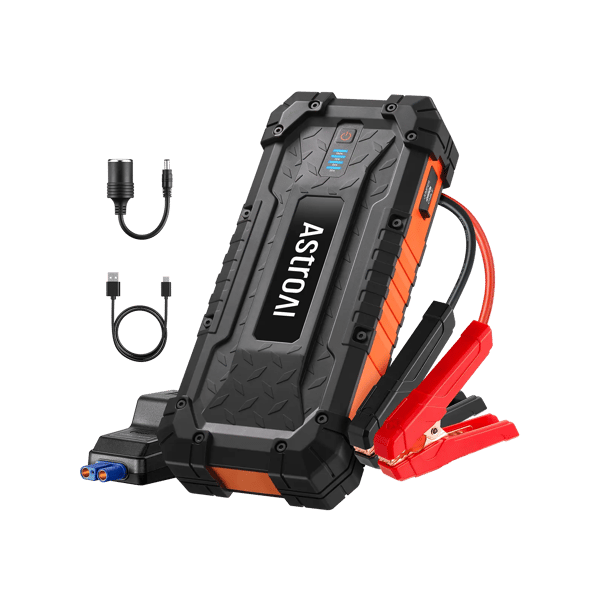
Main recommendation for broader engine coverage
AstroAI S8 Ultra Jump Starter
Best for: Households with larger gas or diesel vehicles, mixed vehicle sizes, or drivers who want more internal capacity.
- 4000A peak output
- Up to 10.0L gas / 8.0L diesel engines
- 24000mAh battery capacity
- 12V lithium-ion system
- USB quick-charge function listed on the product page
Pros: Broad listed engine coverage and greater capacity for a travel emergency kit.
Cons: More capacity and coverage may be unnecessary for a small passenger car.
Skip it if: Your vehicle fits comfortably within S8's rating and compact simplicity matters more than added capacity.
View AstroAI S8 Ultra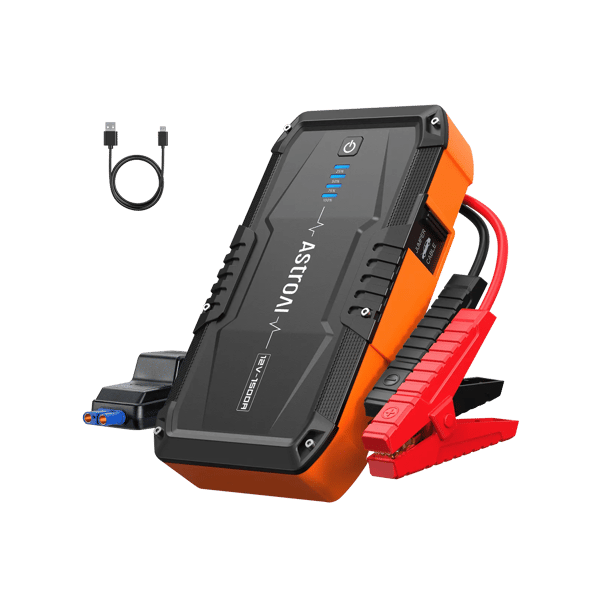
Practical passenger-vehicle option
AstroAI S8 Jump Starter
Best for: Common cars, crossovers, motorcycles, and compatible 12V vehicles that stay within its listed engine range.
- 1500A peak output
- Up to 6.0L gas / 3.0L diesel engines
- 10000mAh battery capacity
- 12V NMC battery system
- Three-mode flashlight listed on the product page
Pros: A focused feature set for many everyday vehicles without paying for unused engine headroom.
Cons: Not the right choice for engines beyond its 6.0L gas / 3.0L diesel rating.
Skip it if: You need larger-engine coverage or tire inflation in the same tool.
View AstroAI S8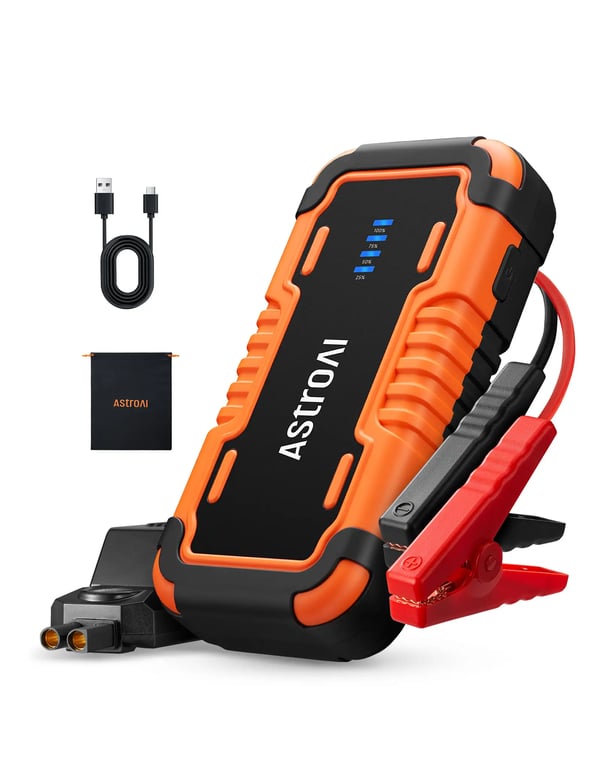
Higher peak-output dedicated option
AstroAI P10 Jump Starter
Best for: Drivers who prioritize a 5000A dedicated jump starter while remaining within the listed 10.0L gas / 8.0L diesel range.
- 5000A peak output
- Up to 10.0L gas / 8.0L diesel engines
- 12V lithium jump box
- Portable dedicated jump-starter format
Pros: The highest listed peak output among the three primary recommendations.
Cons: Its 5000A figure does not expand the listed engine ceiling beyond S8 Ultra's range.
Skip it if: Your vehicle fits S8's range or you need a built-in air compressor.
View AstroAI P10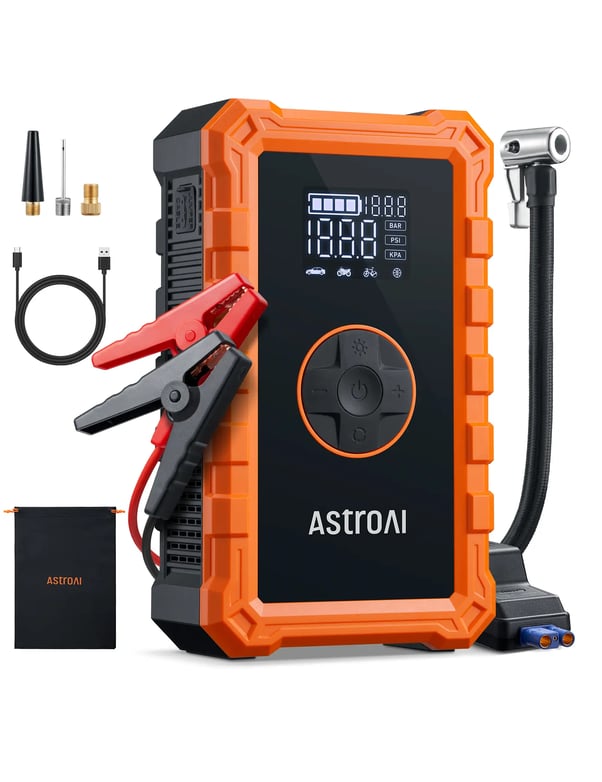
Two-in-one emergency alternative
AstroAI S8 Air Jump Starter with Air Compressor
Best for: Commuters and road-trip drivers who want one charged device for a weak 12V battery and a safely inflatable low tire.
- 3000A jump starter
- Up to 6.0L gas / 3.0L diesel engines
- 150 PSI air compressor
- 10000mAh battery capacity
- 12V NMC battery system
Pros: Covers two common roadside problems without carrying separate powered devices.
Cons: More components to store and maintain, and it does not repair tire damage.
Skip it if: You already own a reliable inflator or need engine coverage beyond 6.0L gas / 3.0L diesel.
View AstroAI S8 AirS8 Ultra vs. S8 vs. P10 vs. S8 Air
| Model | Peak Output | Listed Engine Range | Distinct Role |
|---|---|---|---|
| S8 Ultra | 4000A | Up to 10.0L gas / 8.0L diesel | Broader engine coverage plus 24000mAh capacity |
| S8 | 1500A | Up to 6.0L gas / 3.0L diesel | Focused everyday passenger-vehicle option |
| P10 | 5000A | Up to 10.0L gas / 8.0L diesel | Highest peak number among these dedicated options |
| S8 Air | 3000A | Up to 6.0L gas / 3.0L diesel | Jump starter plus 150 PSI air compressor |
Do You Need a Jump Starter with an Air Compressor?
You need both functions when low tire pressure and a weak 12V battery are realistic parts of the same travel plan. You do not necessarily need them in one housing. The decision is about convenience, engine compatibility, storage, and the tools you already own.
| Choose a Two-in-One Unit If... | Choose a Dedicated Jump Starter If... |
|---|---|
| You want one charged device for battery and tire-pressure emergencies. | You already carry a reliable tire inflator or use a separate air source. |
| Your engine fits within S8 Air's 6.0L gas / 3.0L diesel rating. | You need the broader 10.0L gas / 8.0L diesel rating of S8 Ultra or P10. |
| You are willing to check battery charge, hose, and inflation accessories together. | You prefer fewer controls and a tool focused on engine starting. |
| Trunk organization is easier with one multi-function device. | You prefer separate tools so one depleted battery does not remove both functions. |
A Compressor Is Not a Tire Repair
S8 Air can add air to a safely inflatable tire, but it cannot seal a puncture, repair sidewall damage, or make a rapidly leaking tire safe for highway travel. Inspect first and seek tire service when pressure will not hold.
How to Use a Portable Jump Starter Safely
Always follow the vehicle owner's manual and the specific jump starter manual. The steps below describe the general sequence for a compatible 12V vehicle; vehicle-specific jump points and restrictions take priority.
1. Confirm compatibility
Verify the vehicle uses an approved 12V jump-start procedure and that its engine size is within the jump starter's rating.
2. Stop and inspect
Park safely, switch off accessories, and do not jump-start a leaking, swollen, physically damaged, or otherwise unsafe battery.
3. Identify approved terminals
Locate the positive terminal and the approved negative terminal or ground point specified by the vehicle manufacturer.
4. Connect the clamp module
Attach the clamp cable to the jump starter as directed, keeping the clamps separated and the pack switched off until instructed.
5. Connect positive, then negative
Connect red to the approved positive point and black to the approved negative point or chassis ground, following both manuals.
6. Check the status indicator
Proceed only when the jump starter indicates a correct connection. Do not use boost or override mode casually; follow its specific instructions.
7. Make a brief start attempt
Try to start the vehicle without prolonged cranking. Stop and review the instructions if it does not start after the permitted attempts.
8. Disconnect and recharge
After a successful start, disconnect in the order specified by the manuals, arrange a battery check, and recharge the jump starter before returning it to storage.
When a Jump Starter Will Not Solve the Problem
A no-start condition is not always a discharged battery. A jump starter may power the vehicle but still fail to start an engine with a faulty starter motor, damaged battery, poor terminal connection, fuel-delivery problem, immobilizer issue, or other electrical or mechanical fault.
- Bright lights with a single click: the starter circuit may need diagnosis.
- No electrical response: inspect approved connections and battery terminals before assuming more amps are needed.
- Engine cranks normally but does not fire: the problem may not be battery-related.
- Battery is swollen, leaking, hot, or visibly damaged: do not attempt a jump-start; seek qualified help.
- Vehicle starts but soon stops again: the charging system or battery may require service.
How to Keep a Jump Starter Ready All Summer
| When | What to Check | Why It Matters |
|---|---|---|
| Before a long trip | Charge level, clamps, cables, case, flashlight, and accessories | Confirms the complete kit is ready before luggage blocks access |
| During regular storage | Charge status according to the product manual | Lithium battery packs self-discharge and are easy to forget |
| After any jump-start | Recharge the pack and inspect clamps for heat or damage | Returns the tool to emergency-ready condition |
| In hot weather | Storage temperature limits in the manual | Avoid leaving the pack where temperatures exceed its approved range |
Common Jump Starter Buying and Use Mistakes
- Buying by peak amps alone. Check engine displacement, fuel type, 12V compatibility, and official engine rating.
- Assuming every vehicle can be jump-started the same way. Use the owner's manual, especially for hybrids, EVs, and vehicles with remote jump points.
- Leaving the pack discharged. Build charge checks into seasonal vehicle maintenance.
- Storing clamps separately. Keep the complete cable set and charger with the pack.
- Using override mode as the default. Boost or override functions require the exact product instructions and additional caution.
- Making repeated long start attempts. Prolonged cranking can overheat components and may not solve a non-battery fault.
- Treating a successful jump as a repair. Have the battery and charging system checked if the cause is unknown or the problem returns.
- Assuming a combo compressor repairs tires. It adds air only when the tire is safe to inflate.
Bottom Line
A compatible, charged jump starter is valuable summer equipment because it turns a weak 12V battery from a wait-for-help problem into a situation you may be able to manage independently. The right size is not automatically the model with the largest peak-amp number. Start with the official engine rating and vehicle procedure, then choose the capacity and features that fit your travel pattern.
S8 is the straightforward choice for many passenger vehicles. S8 Ultra adds broader engine coverage and 24000mAh capacity. P10 offers 5000A peak output within the same listed 10.0L gas / 8.0L diesel range. S8 Air is the better fit when one device needs to support both battery recovery and tire-pressure top-offs for a vehicle within its rating.
Frequently Asked Questions
How many peak amps do I need for a jump starter?
Choose a model whose official engine-size and fuel-type rating covers your vehicle. Peak amps are useful for comparing models, but they should not replace the manufacturer's 12V and engine compatibility information.
Is 1500 peak amps enough for a car?
It can be enough when the vehicle is within the jump starter's official rating. AstroAI S8 is rated up to 6.0L gas and 3.0L diesel engines, so confirm your engine and follow the vehicle manual.
Is a 5000A jump starter always better than a 4000A model?
No. P10 lists 5000A and S8 Ultra lists 4000A, but both are rated up to 10.0L gas and 8.0L diesel. Capacity, size, functions, and the official compatibility rating may matter more than the extra peak-current number.
Do I need a jump starter with an air compressor?
Choose a combo unit if you want one charged device for both low tire pressure and a weak 12V battery. Choose a dedicated jump starter if you already have an inflator, need broader engine coverage, or prefer separate tools.
What is the difference between S8 and S8 Air?
S8 is a 1500A dedicated jump starter with a 10000mAh battery. S8 Air combines a 3000A jump starter and a 150 PSI air compressor. Both list coverage up to 6.0L gas and 3.0L diesel engines.
Can a jump starter start a completely dead battery?
Possibly, if the battery and vehicle are otherwise safe and compatible, but some packs require a specific boost procedure for very low voltage. Follow both manuals and never use override mode without understanding its instructions.
Can I use a portable jump starter on an EV or hybrid?
Never use it on the high-voltage traction battery. The 12V auxiliary battery may be jump-startable on some EVs and hybrids, but NHTSA advises referring to the owner's manual for the correct procedure and battery location.
How often should I recharge a portable jump starter?
Follow the product manual's storage and recharge interval, check the charge before every long trip, and recharge after each use. Regular checks are more reliable than waiting for a seasonal emergency.
Will a jump starter fix a bad car battery?
No. A jump starter supplies temporary starting power. If the battery repeatedly goes flat, will not hold charge, is damaged, or the vehicle stops again, arrange battery and charging-system diagnosis.
Where should I store a jump starter during summer?
Store it securely, dry, accessible, and within the temperature limits in its manual. Do not leave it loose under cargo or in a location where vehicle heat exceeds the approved storage range.