What to Pack for a Summer Road Trip
July 8th , 2026 | AstroAI *

What to Pack for a Summer Road Trip
A good summer road trip kit is not just a box of random tools. It should help you understand a warning light, add air when pressure is low, restart a weak battery, stay visible at night, keep phones powered, and handle small checks without turning a simple stop into a long delay.
Quick Answer: What Should You Pack First?
Pack around problems, not around products. Start with a tire pressure gauge, a portable tire inflator, a jump starter or jump starter with air compressor, a flashlight or USB power source, and a small set of basic electrical and hand tools. If the TPMS light comes on, pull over safely, inspect the tire, check pressure with a gauge, and inflate to the vehicle placard PSI. If you want one compact device for both low tire pressure and a weak battery, consider a jump starter with air compressor such as the AstroAI S8 Air or A30; if you prefer a tire-only setup, pair a gauge with the AstroAI C2 or the lighter AstroAI L7.
1. Think in Problems First: Tires, Battery, Visibility, Power, and Small Repairs
Most packing lists become too long because they start with every possible item. A better road-trip kit starts with the five problems that can actually interrupt a drive: tire pressure, 12V battery failure, poor visibility, phone or USB power loss, and small mechanical or electrical checks. Each problem needs a different tool, which is why one inflator or one jump starter cannot be the whole kit.
A gauge answers the first question
Before adding air, you need to know whether the tire is actually low and by how much. This matters when a TPMS light appears but the tire does not look flat.
An inflator solves only the air problem
A portable inflator helps after you confirm low pressure. It does not diagnose a puncture, repair a tire, or start the car battery.
A jump starter solves a different failure
Battery trouble usually shows up as slow cranking, repeated clicking, dim lights, or no start after accessory use. Tire tools cannot solve that.
2. Summer Road Trip Emergency Kit Checklist
Use this checklist for passenger cars, crossovers, family trips, campus move-ins, weekend getaways, national park drives, and longer highway routes. Trucks, trailers, RVs, and oversized tires may need heavier-duty tools matched to tire volume and load.
| Kit layer | What to pack | What it prevents | Keep it where? |
|---|---|---|---|
| Tire pressure | Tire pressure gauge, valve caps, portable inflator, tire repair information | Guessing after a TPMS light, driving on an underinflated tire, or hunting for a working gas-station pump | Gauge in cabin or door pocket; inflator in trunk but accessible |
| Battery | Jump starter or jump starter with air compressor, charged power bank, USB cables | A no-start situation after accessory use, old battery weakness, or long stops with phones charging | Cargo area, not under heavy luggage |
| Visibility | Flashlight, headlamp, reflective vest, warning triangle, gloves | Dark roadside work, poor visibility, and unsafe searching in the trunk at night | Glove box or side cargo pocket |
| Small checks | Small screwdriver set, electrical tape, spare vehicle-matched fuses, compact meter if you know how to use it | Loose battery terminals, blown accessory fuses, and small non-invasive checks | Tool pouch in trunk side compartment |
| People and comfort | Water, snacks, first aid, medication, sunscreen, wipes, trash bags, paper towels | Fatigue, heat discomfort, messy delays, and passenger stress | Cabin, not buried under luggage |
3. What to Do When the TPMS Light Comes On
A TPMS light is not a diagnosis by itself. It is a prompt to slow down, check the tire situation, and make the next decision based on actual pressure and visible condition. That is why a gauge and inflator work better together than either one alone.
- Move away from traffic and park on a flat, stable surface.
- Look for visible tire damage, a puncture, a flat tire, or unusual heat or smell.
- Use a tire pressure gauge to check every tire you can safely access, including the spare if your vehicle carries one.
- Inflate low tires to the vehicle placard or owner manual pressure, not the tire sidewall maximum.
- If one tire keeps losing pressure, the warning returns, or steering feels abnormal, stop using that tire and get service.
| What you see | What it usually means | What to do next |
|---|---|---|
| Light comes on and tire looks normal | Pressure may be low enough to trigger the system but not visibly obvious | Check with a gauge, inflate if needed, then monitor |
| One tire is much lower than the others | Possible leak, puncture, valve issue, or recent impact | Inflate only enough to reach a safe service point if the tire holds air |
| Light flashes or warning returns | System fault or repeated pressure loss may be present | Stop relying on inflation alone and get the vehicle checked |
4. Do You Need Both a Jump Starter and an Air Compressor?
You need both capabilities if the goal is roadside readiness. The choice is whether to carry them as separate tools or combine them in one jump starter with air compressor. Separate tools give redundancy and simple access; a 2-in-1 tool saves space and is easier to remember during packing.
| Setup | When it makes sense | Pros | Cons |
|---|---|---|---|
| Gauge + dedicated inflator | Tire-focused kits, newer vehicles, short highway trips, drivers who already have roadside assistance | Simple, direct, easy to use for routine top-offs | Does not help when the vehicle will not start |
| Gauge + jump starter with air compressor | Most road-trip emergency kits, limited trunk space, older batteries, family cars | Covers low tire pressure and weak battery in one device | Usually larger than a tire-only inflator |
| Gauge + inflator + separate jump starter | Long trips, remote routes, multi-car households, vehicles with high accessory use | Best redundancy and easier shared use | More tools to store, charge, and remember |
5. How Many Peak Amps Do You Need for a Jump Starter?
Peak amps are useful only when they are read together with engine compatibility. A compact car, a gasoline SUV, and a diesel truck do not ask the same thing from a jump starter. Battery age, temperature, accessory drain, and how long the car has been sitting also matter.
| Trip or vehicle profile | What to prioritize | AstroAI direction |
|---|---|---|
| Passenger car, crossover, motorcycle, short summer trips | Compact storage, easy jump-starting, tire inflation in one kit | S8 Air: 3000A, 150 PSI compressor, 6.0L gas / 3.0L diesel listing |
| Family van, SUV, camping route, older battery | More engine-size headroom and broader emergency coverage | A30: 4000A, 150 PSI compressor, 10.0L gas / 8.0L diesel listing; add L7 only if you want a separate lightweight tire-inflation backup |
| Larger SUV, diesel, truck-style travel, longer-distance emergency kit | Higher peak current, larger engine compatibility, stronger reserve | A30: 4000A, 150 PSI compressor, 10.0L gas / 8.0L diesel listing |
AstroAI kit suggestions
Choose the tool by the job it handles.
For a road trip article, the point is not to push one device into every scenario. The more useful approach is to decide what role is missing in the car: pressure checking, tire inflation, jump starting, or a combined emergency tool.
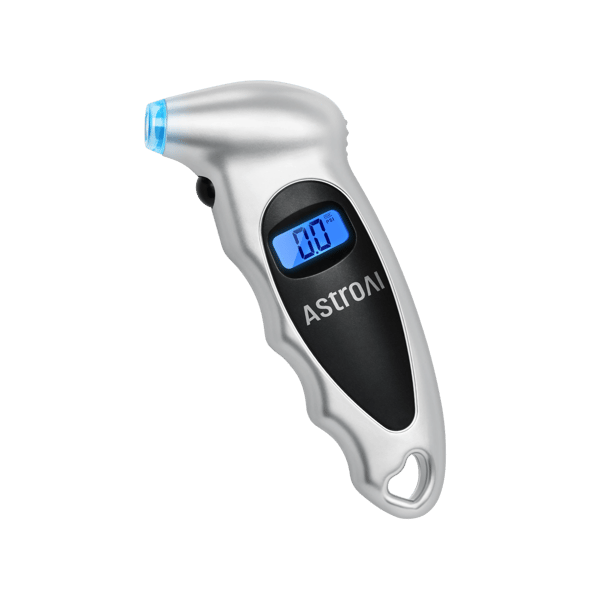
Start with measurement
AstroAI Digital Tire Pressure Gauge 150 PSI
Best for: Cold tire pressure checks before departure, after a TPMS warning, and before adding air.
Not best for: It measures pressure only; it does not inflate, seal, or repair a tire.
- Range: 0-150 PSI
- Increment: 0.1 PSI
- Display: Backlit LCD
- Power: Lithium coin batteries included
- Weight: 2.88 oz
- Pros: strong fit for a core road trip kit
- Cons: should be paired with the other emergency items in this guide
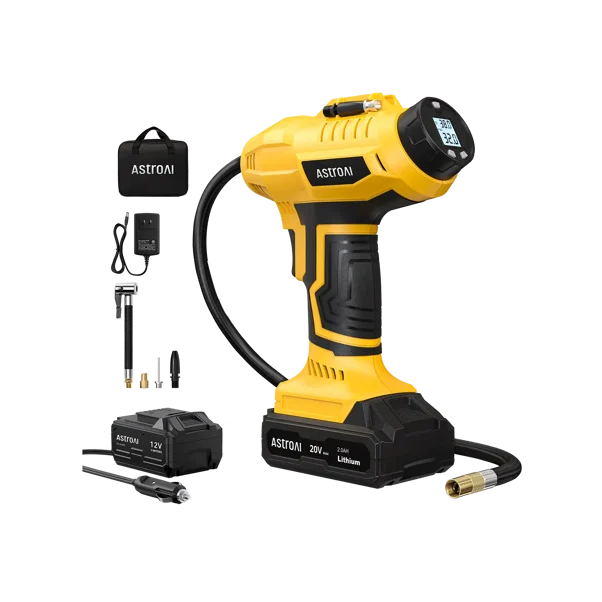
Dedicated inflator option
AstroAI C2 Handheld Cordless Tire Inflator
Best for: Routine top-offs, driveway checks, rest stops, and trips where cordless use plus 12V backup power matters.
Not best for: It is not a jump starter and is not meant to replace heavy-duty truck or RV inflation equipment.
- Max pressure: 160 PSI
- Power source: 20V lithium battery and 12V DC adapter
- Pressure units: KPA, PSI, BAR
- Features: Automatic shut-off, real-time monitoring screen, dual power supply
- Hose length: 19.7 in
- Pros: strong fit for a core road trip kit
- Cons: should be paired with the other emergency items in this guide
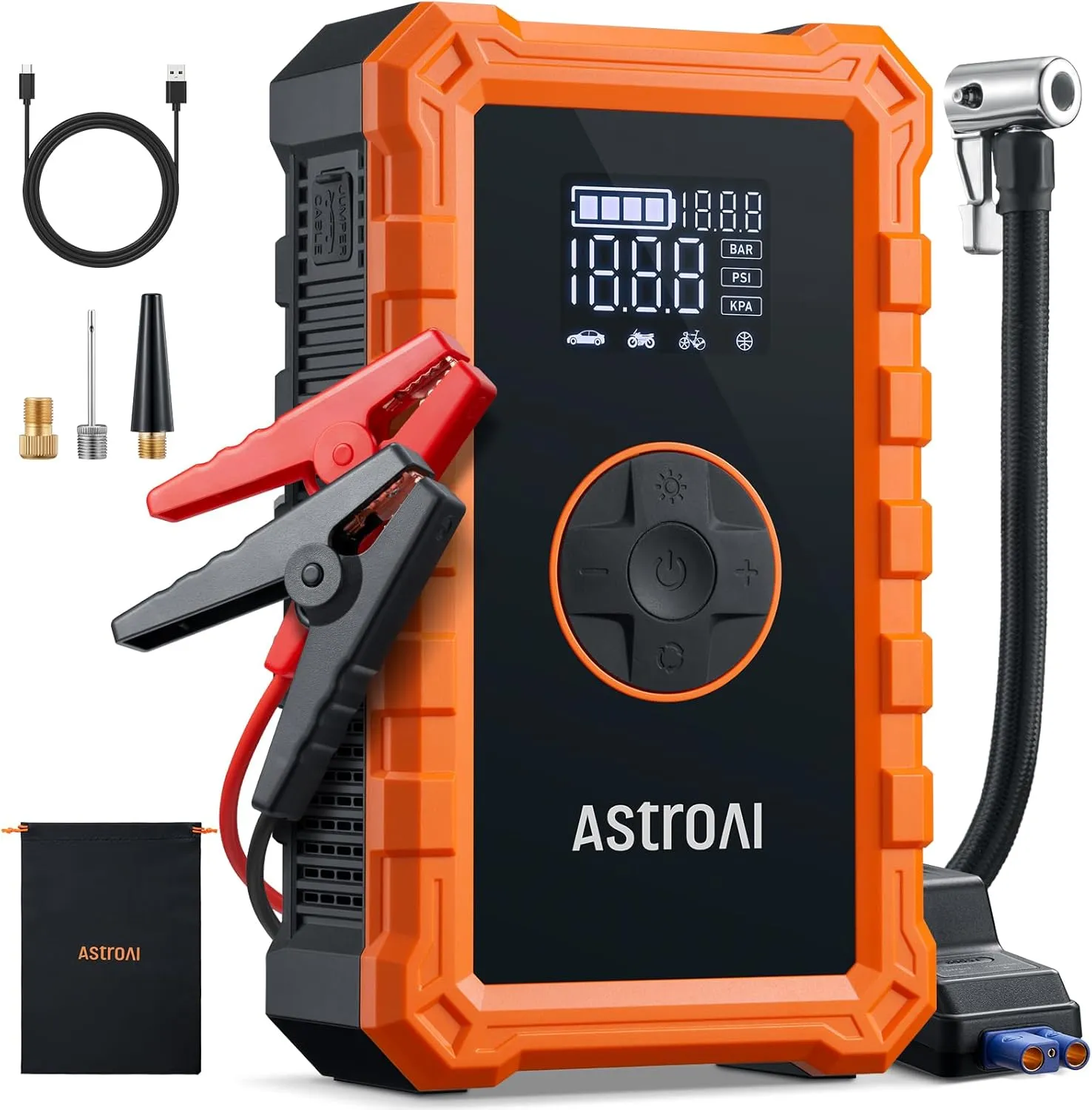
Compact two-in-one option
AstroAI S8 Air Portable Jump Starter with Air Compressor
Best for: Drivers who want one compact tool for a weak 12V battery and low tire pressure.
Not best for: It does not remove the need for a separate pressure check and is not a substitute for tire repair.
- Peak current: 3000A
- Air compressor: 150 PSI
- Engine rating: 6.0L gas / 3.0L diesel
- Battery capacity: 10000mAh
- Weight: 2.43 lb
- Pros: strong fit for a core road trip kit
- Cons: should be paired with the other emergency items in this guide
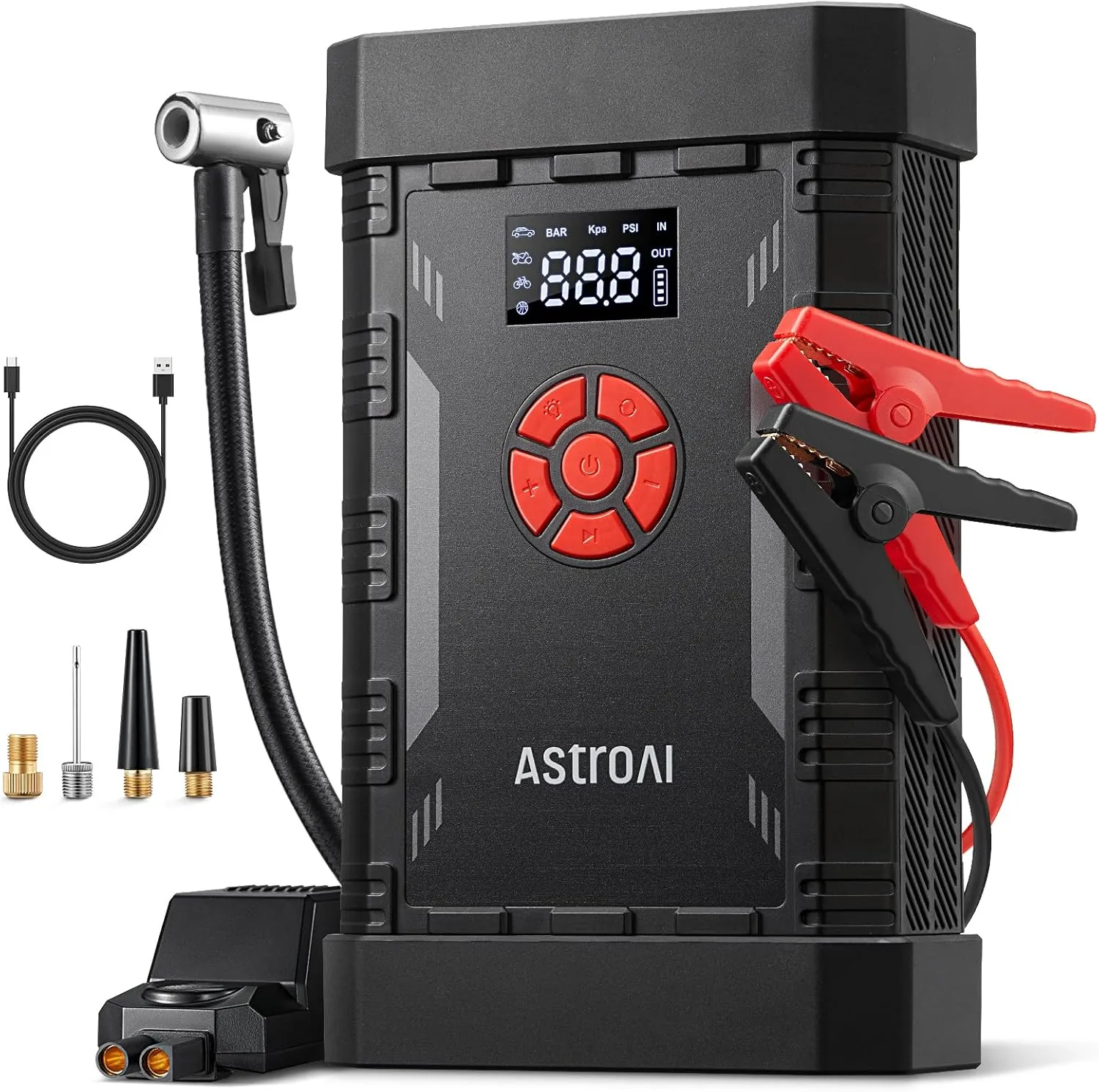
More peak-amp headroom
AstroAI A30 Jump Starter with Air Compressor
Best for: SUVs, vans, larger emergency kits, and drivers who want more starting-power headroom.
Not best for: It is less minimal than a small tire-only kit and should be matched to storage space and vehicle needs.
- Peak current: 4000A
- Air compressor: 150 PSI
- Engine rating: 10.0L gas / 8.0L diesel
- Inflation speed: 20 L/min
- Weight: 1.76 lb from AstroAI comparison table
- Pros: useful when this exact role matters
- Cons: should be paired with the other emergency items in this guide
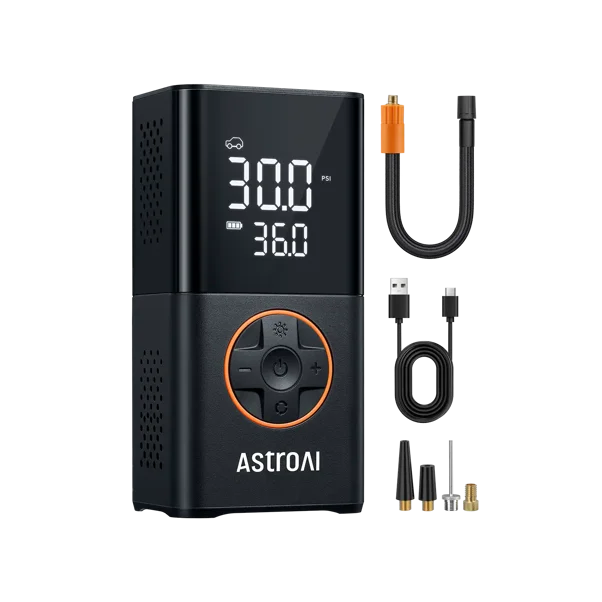
If you want a lighter tire-only backup
AstroAI L7 Portable Tire Inflator
L7 is worth considering when the car already has a jump-start plan and the missing piece is a smaller battery-powered inflator for pressure top-offs, bikes, motorcycles, or compact packing.
View AstroAI L7 →6. Product Snapshot for the Tools Mentioned Above
Snapshot checked on 2026-07-07. Product specs, availability, and review counts can change, so confirm current details on each product page before purchase.
| Product | Role in the kit | Visible specs | Rating / SKU snapshot |
|---|---|---|---|
| AstroAI Digital Tire Pressure Gauge 150 PSI | Pressure check tool | Range: 0-150 PSI; Increment: 0.1 PSI; Display: Backlit LCD; Power: Lithium coin batteries included; Weight: 2.88 oz | 4.7 rating from 437 reviews; SKU 1000417558 |
| AstroAI C2 Handheld Cordless Tire Inflator | Dedicated tire inflator | Max pressure: 160 PSI; Power source: 20V lithium battery and 12V DC adapter; Pressure units: KPA, PSI, BAR; Features: Automatic shut-off, real-time monitoring screen, dual power supply; Hose length: 19.7 in | 4.8 rating from 334 reviews; SKU B0948WY5YX |
| AstroAI S8 Air Portable Jump Starter with Air Compressor | Compact two-in-one emergency tool | Peak current: 3000A; Air compressor: 150 PSI; Engine rating: 6.0L gas / 3.0L diesel; Battery capacity: 10000mAh; Weight: 2.43 lb | 4.8 rating from 291 reviews; SKU B0D2HDJ2TM |
| AstroAI L7 Portable Tire Inflator | Lightweight tire-inflation backup | Max pressure: 150 PSI; Battery capacity: 4000mAh; Power source: Battery; Pressure units: PSI, KPA, BAR, KG/CM2; Weight: 1.17 lb | 4.7 rating from 2319 reviews; SKU B0CS3B7MD8 |
| AstroAI A30 Jump Starter with Air Compressor | Higher peak-amp two-in-one option | Peak current: 4000A; Air compressor: 150 PSI; Engine rating: 10.0L gas / 8.0L diesel; Inflation speed: 20 L/min; Weight: 1.76 lb from AstroAI comparison table | 4.5 rating from 101 reviews; SKU B0DZXG4LZ4 |
7. Pack by Trip Type, Not Just by Distance
A two-hour beach drive, a three-day family highway trip, and a mountain camping route create different emergency needs. Distance matters, but load, weather, tire size, road surface, passengers, and access to service matter more.
| Trip type | Extra risk | Packing emphasis |
|---|---|---|
| Beach or city weekend | Heat, traffic, parking delays, phone drain | Water, USB power, gauge, compact inflator, wipes, sun protection |
| Family highway trip | Heavier vehicle load, passenger comfort, longer stop intervals | Gauge, inflator, jump starter, first aid, snacks, paper towels, accessible warning gear |
| Camping or park route | Remote service, night setup, bikes or small inflatables, unpaved parking areas | Jump starter with air compressor for battery plus tire coverage, or L7 as a lighter tire-only backup when jump-starting is covered separately |
| Older vehicle or unknown battery age | Slow cranking, accessory drain, heat stress | Jump starter, terminal check, spare fuses, compact light, planned battery check before departure |
8. Put the Kit Where You Can Reach It
A packed tool is only useful if you can reach it without unloading the whole car. Before departure, decide what belongs in the cabin, what belongs in the trunk side pocket, and what can stay under the cargo floor.
Cabin items
Phone cable, water, medication, flashlight, tire gauge, wipes, sunglasses, documents.
Quick trunk items
Inflator, jump starter, gloves, warning triangle, vest, first aid, towel, trash bags.
Deep storage
Backup clothes, extra water, non-urgent gear, larger picnic or camping supplies.
9. Final Packing Sequence Before You Leave
The simplest routine is: check first, charge second, pack third, and place emergency tools last so they stay accessible. That order prevents the common mistake of buying the right tools and then burying them under luggage.
- Check cold tire pressure before the car is fully loaded.
- Charge the inflator, jump starter, power bank, and flashlight.
- Pack water, first aid, documents, and passenger essentials where they can be reached.
- Place the gauge, gloves, warning gear, flashlight, inflator, and jump starter in an accessible area.
- After loading, confirm mirrors, visibility, tire appearance, fuel or charging plan, and navigation before moving.
Bottom line: The most useful road trip kit is layered. Use a tire gauge to understand the warning, an inflator to correct low pressure, a jump starter or two-in-one tool to handle battery trouble, and basic light, USB, and hand tools to keep small problems from becoming trip-stopping delays.
FAQ
What should I do when the TPMS light comes on during a road trip?
Pull over when it is safe, inspect the tires, check pressure with a gauge, and inflate any low tire to the vehicle maker's cold-pressure recommendation. If the tire is visibly damaged, losing pressure quickly, or the warning flashes and then stays on, stop driving and arrange service.
Do I need both a jump starter and an air compressor?
Many road-trip kits should include both capabilities because low tire pressure and a weak battery are different problems. You can carry separate tools or choose a jump starter with air compressor, but a separate pressure gauge is still useful for quick checks.
How many peak amps do I need for a jump starter?
Match peak amps to your engine size and the jump starter's listed gas and diesel rating. Smaller gasoline cars usually need less headroom, while SUVs, vans, diesel engines, cold starts, older batteries, and long accessory use call for more reserve.
Why not carry only a portable tire inflator?
A tire inflator helps with low tire pressure, but it will not restart a dead battery, light a dark work area by itself, tighten a loose terminal, or verify electrical power. A complete emergency kit covers tires, battery, visibility, charging, and simple hand-tool needs.
Should I use the tire sidewall PSI or the vehicle door placard?
Use the vehicle door placard or owner manual for normal inflation pressure. The tire sidewall usually shows the tire's maximum rating, not the recommended pressure for your loaded vehicle.
Is a 2-in-1 jump starter with air compressor better than separate tools?
A 2-in-1 tool is better when storage space is limited and you want dead-battery and low-pressure coverage in one device. Separate tools can be better when you want redundancy, faster tire-only access, or a lighter daily-carry setup.
What basic electrical tools should go in a road trip kit?
Pack a compact multimeter or voltage tester if you know how to use it, a small screwdriver set, spare fuses matched to your vehicle, electrical tape, and USB charging cables. Do not attempt roadside electrical repair beyond your skill level.
Where should emergency tools be stored in the car?
Keep the tire gauge, warning gear, flashlight, and gloves where they can be reached without unloading the trunk. Larger tools can stay in the cargo area, but they should not be buried under luggage.